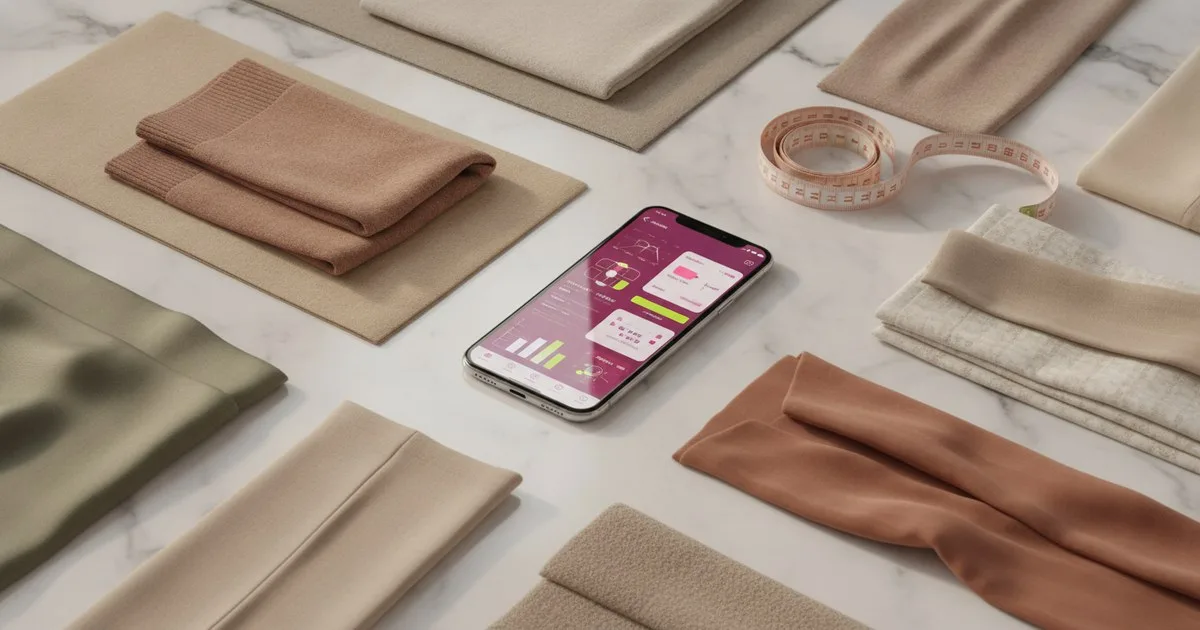
The days of scrolling through hundreds of product pages hoping something catches your eye are numbered. AI personal shopping assistants now sit between you and the inventory, reading your preferences, your body shape, your past purchases and even the weather in your city to decide what you see first. That invisible edit is already reshaping which brands reach consumers — and which ones quietly disappear from view.
Key takeaways
- Nearly half of online shoppers say they feel positive about having an AI assistant that finds fashion items based on their preferences, according to Mintel research on the UK fashion technology market.
- AI discovery tools do not just personalise — they act as gatekeepers, and brands that do not optimise for them risk being filtered out entirely.
- Virtual try-on is moving from standalone apps into the core search experience, making the try-before-you-buy moment part of the discovery moment.
- Retailer-embedded AI and platform-level AI operate by different logics, and understanding both helps you shop — and helps brands reach you.
- The signals AI reads go far beyond your click history: social trends, real-time inventory and even return rates all feed the ranking.
What exactly is an AI personal shopping assistant?
An AI personal shopping assistant is software that uses machine learning to match products to an individual shopper rather than showing the same catalogue to everyone. At the simplest end, that means a recommendation widget that says 'you might also like'. At the more sophisticated end, it means a conversational interface that understands a prompt like 'I need a midi dress for a rooftop dinner in late September, I run warm, and I hate dry-clean only' and returns a curated shortlist with size guidance.
The key distinction from traditional search is intent understanding. A keyword search for 'navy midi dress' returns everything tagged that way. An AI assistant interprets the full context of the request — occasion, climate, care preference, your past returns — and filters accordingly. That is a fundamentally different relationship between shopper and inventory.
How do these tools decide what surfaces to you?
The ranking logic varies by platform, but most AI shopping tools draw on a combination of signals:
- Behavioural history: what you have clicked, saved, bought and returned.
- Visual similarity: computer-vision models that identify style attributes — silhouette, colour palette, fabric texture — and match them to your demonstrated preferences.
- Social and trend signals: aggregate data on what is gaining traction on social platforms, weighted by your demographic or style cluster.
- Inventory and margin data: some retailer-embedded tools quietly weight results toward in-stock, full-price items — a commercial reality worth knowing.
- Return-rate signals: items with high return rates in your size or body-type cluster may be demoted, even if they look appealing.
The practical result is that two shoppers searching the same term on the same platform on the same day can see entirely different results. Your feed is not the catalogue — it is a curated slice of it.
Where is this already happening?
Google Try-On and the search-level shift
The most significant structural change in AI fashion discovery is happening at the search layer. Google Try-On is now integrated directly into Google Search and Google Shopping, powered by the Gemini 2.5 Flash Image model. You upload a photo of yourself and see apparel items rendered on your body within the search results — no app download, no separate platform. The try-before-you-buy moment has merged with the discovery moment.
This matters enormously for brands. A report by Just Style noted that AI assistants are prompting brands and retailers to fundamentally rethink how their products are discovered online, with product data quality and structured content becoming critical to whether items appear in AI-generated results at all. If your product feed is poorly tagged, an AI assistant may never surface you — regardless of how good the garment is.
Google is deepening this integration rather than spinning it off. The standalone Doppl app was shut down in 2026, with the technology folded into core Search and Shopping surfaces. The direction is clear: AI try-on becomes part of how everyone searches, not a feature for early adopters.
Retailer-embedded AI: the Zalando model
Zalando — which connects 62 million active customers with more than 7,000 brands across 29 European markets — is one of the clearest examples of what retailer-embedded AI looks like at scale. The platform uses AI to personalise the browse experience, surface size recommendations and adapt the catalogue view to individual preference signals. Zalando is also accelerating what it describes as agentic engineering: AI systems that can take multi-step actions on a shopper's behalf, not just return a ranked list.
For the shopper, this means the Zalando you see is not the Zalando your friend sees. For a brand listed on the platform, it means algorithmic visibility is as important as product quality. A well-photographed item with rich attribute tagging will consistently outperform a comparable item with sparse data.
Enterprise AI orchestration: the infrastructure behind the experience
Vue.ai illustrates the infrastructure layer that powers many of these consumer-facing experiences. Its enterprise AI platform covers product tagging, automated on-model imagery, virtual dressing rooms, personalised e-commerce journeys and inventory demand forecasting — all as composable modules that retailers can deploy within their own environments. When you see a product image that looks unusually consistent across a large retailer's catalogue, or a size recommendation that feels more accurate than you expected, there is often a platform like this operating behind the scenes.
Vue.ai positions itself as an end-to-end AI orchestrator for retail, promising deployment within 90 days. For consumers, the implication is that AI-driven personalisation is no longer a feature reserved for the largest platforms — mid-market retailers are increasingly able to deploy the same underlying capabilities.
What the AI is actually reading about you
It is worth being specific about the data inputs, because the picture is more nuanced than 'the algorithm knows what you like.'
Most personalisation engines combine explicit signals (your stated size, saved items, wish lists) with implicit signals (how long you hover on an image, which photos you zoom into, how quickly you scroll past a category). Visual AI adds another layer: if you consistently click on items with a relaxed fit and a muted palette, the model learns that preference even if you have never articulated it.
Social trend data feeds in from image-recognition systems that scan public posts to identify which silhouettes, colours and details are gaining momentum — and at what speed. That trend velocity is then weighted against your personal history. You might see an emerging trend early if your profile suggests you are a style early adopter; you might see it later, or not at all, if your history skews toward wardrobe classics.
Return behaviour is an underappreciated signal. If shoppers with a similar profile to yours consistently return a particular brand's sizing, the AI may downrank that brand for you before you have ever tried it. That is a form of collective intelligence that can be genuinely useful — or can entrench biases in the data.
What this means for the brands you see
The brands that reach you through AI-mediated discovery are not simply the most popular or the best-reviewed. They are the ones whose product data is structured in a way that AI systems can parse, whose imagery is rich enough for visual AI to classify, and whose return and satisfaction signals are strong enough to sustain algorithmic visibility.
Smaller or newer brands face a structural challenge here. Without the volume of transaction data that trains a personalisation model, they are harder for AI to place confidently. Some platforms are beginning to address this with cold-start solutions — ways of bootstrapping recommendations for new products — but it remains an unresolved tension between discovery diversity and personalisation accuracy.
For consumers, the practical implication is worth sitting with: the AI is optimising for a prediction of what you will buy, not necessarily for what you would love if you encountered it. Serendipity — the unexpected find that becomes a wardrobe staple — is harder to engineer into a system built around predicted preference.
What is still unsolved
AI shopping assistants are genuinely useful, and the technology is improving quickly. But several things remain unresolved:
Transparency: most platforms do not tell you why a product was ranked first. You cannot easily audit the signals that shaped your results.
Filter bubbles: if the AI only shows you what it predicts you will like, your style can calcify. The system reinforces your existing preferences rather than expanding them.
Data equity: shoppers with longer purchase histories on a platform receive more accurate personalisation. New users, or users who shop across many platforms, get a thinner model.
Commercial weighting: the line between 'most relevant for you' and 'most profitable for the retailer' is not always visible. Sponsored placements and margin-weighted ranking exist alongside pure preference signals.
These are not reasons to distrust AI shopping tools — they are reasons to use them with some awareness of how they work. Our coverage of the broader shifts in fashion AI, including the signals that drive investment in this space, explores some of these dynamics in more depth — see our piece on what the recent Whering funding round signals about where the industry is heading, and our weekly review of fashion AI developments from August 2026 for the latest.
How to get more from an AI shopping assistant
- Feed it explicit signals: use wish lists, size preferences and style quizzes where they are offered. Explicit data improves the model faster than implicit behaviour alone.
- Return strategically: your return notes matter. If you specify 'too boxy' rather than just returning, some platforms use that language to refine your profile.
- Search in natural language: conversational queries ('linen trousers for a hot office, not cropped') outperform keyword searches in AI-native tools because they give the model more to work with.
- Vary your browsing: clicking on items outside your usual pattern introduces new signals. If you want the AI to show you something different, you have to show it something different first.
- Check the source of a recommendation: note whether a result is sponsored, algorithmically ranked or editorially curated. The distinction matters for how much weight you give it.
FAQ
How does an AI personal shopping assistant differ from a regular recommendation engine?
A recommendation engine typically uses collaborative filtering — 'people like you bought this.' An AI personal shopping assistant combines that with natural-language understanding, visual AI and real-time trend signals, allowing it to interpret context and occasion, not just purchase history.
Can AI shopping tools really understand my style?
They can model a statistical approximation of your demonstrated preferences. That is useful but not the same as understanding style in a human sense. The model is as good as the signals you give it and the diversity of the training data behind it.
Why do I sometimes see the same products repeatedly?
Repetition usually means the model has high confidence in a narrow set of predictions. Introducing new signals — browsing new categories, using natural-language search — can widen the range.
Do AI assistants favour certain brands over others?
Algorithmic ranking can favour brands with richer product data, stronger sales signals and lower return rates. Sponsored placements also exist. Neither is inherently wrong, but it is worth knowing both factors operate.
Is my shopping data used to train these models?
Policies vary by platform. Most major retailers use anonymised, aggregated behavioural data to improve their models. Check the privacy policy of any platform you use regularly for specifics.
Further reading
- Brands urged to rethink online product discovery as AI reshapes search
- UK Fashion Technology and Innovation Market Report