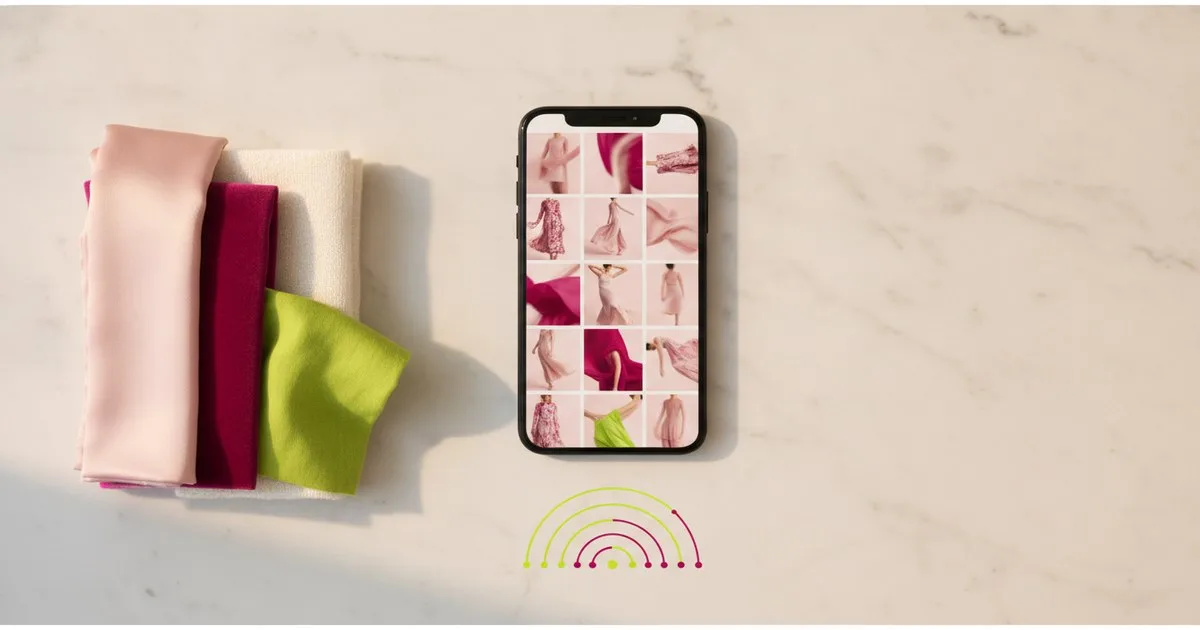
By the time a colour, silhouette or fabric shows up on a shop floor, an AI system has already seen it thousands of times on social media. Platforms built for fashion trend forecasting now scan millions of images, posts and search queries every week, translating that raw signal into buying recommendations that reach merchandising teams months before you ever touch the product. The gap between what is trending online and what lands in stores is shrinking fast, and AI is the reason why.
Key takeaways
- AI trend forecasting tools analyse social imagery at scale, identifying emerging styles weeks or months before they reach retail.
- Computer vision, not keyword search, is the core technology: the system reads garments in photos, not just captions or hashtags.
- Brands use these signals to reduce overproduction and focus buying budgets on styles with demonstrated consumer appetite.
- The pipeline runs from image ingestion through pattern recognition to demand scoring, all before a buyer places a single order.
- Accuracy is improving, but the tools work best when paired with human editorial judgement rather than replacing it.
What does 'reading social signals' actually mean?
The phrase sounds abstract, but the mechanism is specific. A trend forecasting platform does not simply count hashtags or track which influencers are posting. It uses computer vision, a branch of AI that teaches machines to identify objects, colours, shapes and textures inside photographs, to catalogue every visible garment detail across a curated universe of social content.
Think of it as a very fast, very tireless visual analyst. Where a human trend researcher might review a few hundred runway images and street-style shots per week, an AI system processes millions of images in the same period. It can detect that a particular shade of terracotta is appearing more frequently on unstructured blazers in posts from a specific set of cities, or that wide-leg trousers with a low rise are gaining share against slim cuts. None of that requires a caption or a hashtag. The signal is in the image itself.
This matters because the most culturally significant fashion moments often happen in ordinary posts: someone wearing a thrifted find on a Tuesday afternoon, a musician photographed leaving a studio, a street-style shot from a city that is not on the traditional fashion-week circuit. Keyword-based tools miss most of this. Computer vision catches it.
How does the data pipeline work, step by step?
Understanding the pipeline helps you appreciate both what these tools can do and where they fall short.
Step 1: Image ingestion. The platform pulls images from social platforms, e-commerce sites, runway archives and street-style databases. The exact sources vary by vendor, but the ambition is always breadth: the more diverse the input, the earlier a niche signal can be detected before it becomes mainstream.
Step 2: Garment detection and tagging. Computer vision models identify every garment visible in each image and tag it across dozens of attributes: category (jacket, trouser, dress), silhouette, colour, fabric texture, print, closure type, length, and so on. A single image might generate hundreds of data points.
Step 3: Trend signal aggregation. Tagged attributes are aggregated over time and geography. The system tracks whether a given attribute combination is growing, plateauing or declining in frequency. Growth curves that exceed a statistical threshold flag a potential emerging trend.
Step 4: Demand scoring. Not every visual trend translates into purchase intent. Sophisticated platforms layer in additional signals, such as search volume patterns and e-commerce engagement data, to estimate whether consumers are likely to buy the item, not just photograph it. This is where the forecasting becomes commercially useful.
Step 5: Reporting and recommendations. The output reaches buyers, merchandisers and designers in the form of trend reports, colour forecasts and demand projections, typically segmented by market, price tier and consumer demographic. A buyer at a contemporary womenswear label might receive a weekly brief showing which silhouettes are gaining traction in her target market, ranked by projected demand.
Who is doing this at scale?
Heuritech, one of the best-known names in AI-powered fashion trend forecasting, built its platform on exactly this kind of computer-vision pipeline, scanning social imagery to surface trend signals for fashion brands. The company is now part of Luxurynsight, a luxury data-intelligence platform that acquired Heuritech in December 2024. The combined operation integrates Heuritech's visual trend signals into Luxurynsight's broader market-intelligence suite, giving luxury brands a single platform that connects trend data to wider commercial analytics. Luxurynsight has been showcasing this integrated offering at industry events, including Premiere Vision Paris.
As Heuritech's own writing on trend forecasting notes, the omnipresence of social media and live-streamed collections has fundamentally changed how fashion information travels, making AI-assisted analysis not a luxury but a practical necessity for brands trying to keep pace.
Why does this matter to you as a consumer?
You might wonder why any of this is relevant if you are not a buyer or a brand executive. The answer is that this pipeline shapes what you find in stores and online, and at what price.
When brands use AI trend forecasting well, they produce fewer items that nobody wants. The McKinsey State of Fashion report notes that growth in fashion and luxury retail is expected to remain low, which puts pressure on brands to be more precise about what they make and stock. AI trend tools are part of how they respond to that pressure: by chasing signals with genuine consumer appetite rather than guessing.
For you, this means a higher proportion of what you see in stores reflects something that people have already shown interest in, rather than a trend imposed top-down by a design director working from gut instinct alone. It also means faster turnaround: when a style gains traction on social media, AI-equipped brands can respond in weeks rather than the traditional six-to-twelve-month product cycle.
The flip side is real. If every brand is reading the same social signals through similar AI systems, product assortments can converge. The tools amplify what is already popular, which can squeeze out the kind of slow-burn, subcultural originality that used to take years to filter up to the mainstream. As The Guardian reported on AI in fashion forecasting, the ambition is to only produce what can actually be sold, but the creative tension that creates is one the industry is still working through.
What can these tools not do?
The limitations are worth naming clearly.
- They are retrospective by nature. Even the fastest AI pipeline is reading what has already happened on social media. It cannot predict a genuinely novel aesthetic that has not yet appeared anywhere online.
- They struggle with subculture and context. A garment worn ironically, as a costume reference or as subcultural code reads the same to a computer-vision model as one worn sincerely. The model sees the object; it cannot reliably read the meaning.
- They can amplify bias. If the training data over-represents certain demographics, geographies or body types, the trend signals will reflect those gaps. A platform trained heavily on images from a handful of cities will under-weight emerging aesthetics from elsewhere.
- Demand scoring is probabilistic, not certain. A high demand score means a style has correlated signals; it does not guarantee sales. External factors, from economic shifts to a single viral moment, can override even the most confident projection.
The brands that get the most value from these tools treat them as one input among several, combining AI-generated signals with buyer experience, cultural knowledge and direct consumer feedback.
How far ahead can AI forecasting actually look?
This is the question buyers ask most often. The honest answer is that it depends on what you are forecasting.
For colour and silhouette trends, platforms can identify signals with meaningful lead time, sometimes several seasons ahead, because these attributes move through a predictable diffusion curve: they appear first in niche or subcultural contexts, gain traction among early adopters, and then hit the mainstream. AI is good at detecting the early stages of that curve.
For micro-trends, the kind that flare up and fade within a single season, the lead time is shorter but the signal is stronger. A style that goes from niche to ubiquitous on social media in six weeks is exactly what computer-vision platforms are built to catch.
For macro shifts, such as a broad move toward quieter dressing or a generational change in how people relate to luxury, AI tools are less reliable. Those shifts are driven by cultural and economic forces that do not always announce themselves in image data before they arrive.
The most useful framing is not 'how far ahead' but 'how much more signal than noise.' A well-built AI forecasting platform does not eliminate uncertainty; it reduces the amount of guesswork that goes into a buying decision.
What should you take away as a fashion consumer?
The next time you notice that a particular colour or silhouette seems to be everywhere at once, there is a good chance that an AI system flagged it months earlier and that multiple brands responded to the same signal at roughly the same time. That is not coincidence; it is the pipeline working as intended.
Being aware of this changes how you might think about your own wardrobe choices. The styles that reach stores are not random, and they are not purely the product of a designer's vision. They are, increasingly, the output of a system that reads what millions of people are already wearing and amplifies the patterns it finds. That is useful information, whether you choose to ride the wave or deliberately swim against it.
FAQ
How does AI trend forecasting differ from traditional trend forecasting? Traditional forecasting relies on human analysts reviewing runway shows, trade fairs and cultural signals. AI forecasting processes millions of social images automatically, identifying pattern shifts earlier and at a scale no human team could match. The two approaches work best in combination.
Can AI predict a trend that has never appeared online before? No. AI systems learn from existing data, so a genuinely novel aesthetic that has not yet surfaced anywhere online is invisible to them. They excel at detecting early-stage signals, not at imagining what has never existed.
Do all fashion brands use AI trend forecasting now? Adoption varies widely. Larger brands and luxury groups are furthest along. Many independent and mid-size labels still rely primarily on human forecasters, trade publications and buyer intuition, sometimes supplemented by AI tools.
Does AI trend forecasting make fashion less creative? It can, if brands treat the output as a directive rather than a signal. The risk is that chasing the same data leads to homogeneous assortments. Brands that use AI as one input alongside strong creative direction tend to avoid that trap.
How does social image data get collected without privacy issues? Most platforms use publicly available social content and aggregate data rather than tracking individuals. The analysis is at the level of garment attributes across millions of posts, not individual user behaviour. Privacy regulations and platform terms of service shape what data can be used.
Further reading
- Trend forecasting with AI: Fashion's way forward
- The State of Fashion 2026 | McKinsey
- 'You've got to be data-driven': the fashion forecasters using AI | The Guardian