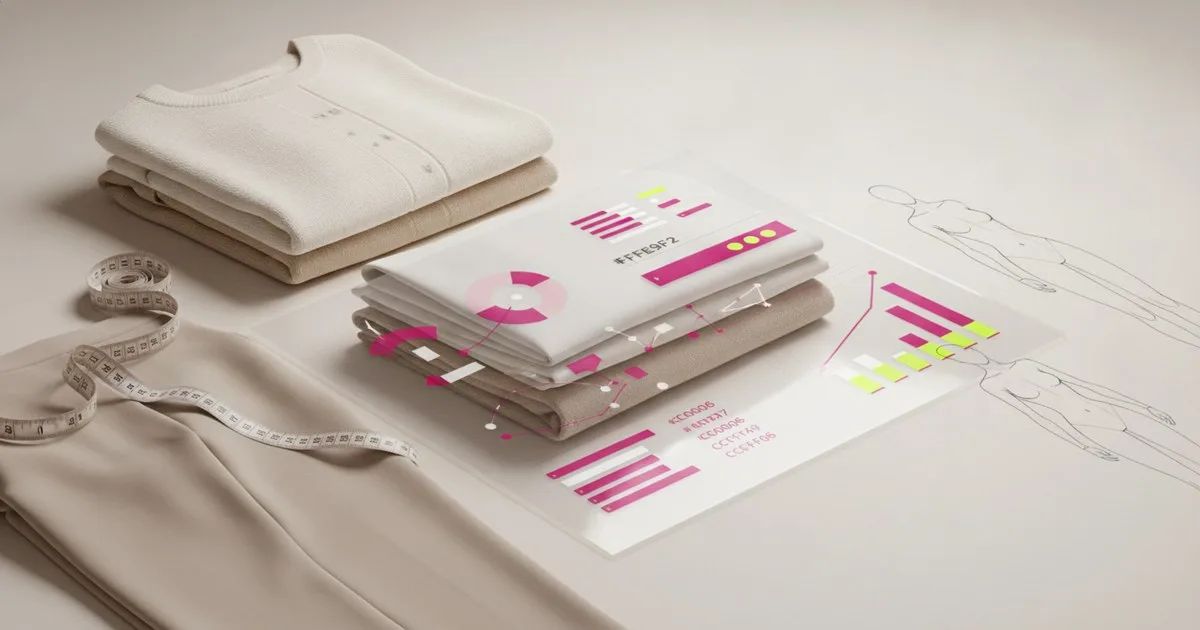
Size recommendation has quietly become one of the most data-intensive problems in fashion retail. Getting it right reduces returns, lifts conversion, and — perhaps most importantly — builds the kind of shopper trust that keeps people buying apparel online. The signals that power these models are not just measurements: they are a layered mix of physical data, behavioral traces, and garment-level specifications, each carrying its own data-quality demands.
This list is for anyone responsible for building or evaluating a fit intelligence stack — product managers, data scientists, and the merchants who brief them. Each entry covers what the signal is, why it matters for model performance, and where the data tends to break down.
Key takeaways
- Body scan data delivers the most precise measurements but requires significant shopper acquisition effort to reach usable scale.
- Return reason codes are high-signal but only useful when retailers enforce a controlled, consistent taxonomy — free-text fields are nearly worthless for training.
- Garment ease preferences, once captured at scale, let models move beyond size charts and into genuine fit personalization.
- Exchange patterns reveal fit failure modes that return data alone cannot surface.
- The weakest link in most fit AI stacks is not the model architecture — it is inconsistent upstream data labeling.
What kinds of body data are retailers actually collecting?
1. 3D Body Scan Measurements
Full-body scan data — captured in a booth, via a handheld device, or increasingly from two smartphone photos — gives models the richest possible input: precise measurements across 50 or more body landmarks, including circumferences, lengths, and proportional ratios that a tape measure in a fitting room would never capture consistently. The appeal is obvious: a model trained on scan data can distinguish between two shoppers who wear the same labeled size but carry their volume differently.
The practical challenge is acquisition. Scan datasets are expensive to build at the scale needed for statistical reliability across size ranges, and the populations who participate in scanning programs skew toward tech-comfortable, urban demographics. Models trained on a narrow scan corpus can perform well for that cohort and poorly for everyone else. Platforms like 3DLOOK have moved toward smartphone-based extraction — their FitXpress product derives 80-plus body measurements from two photos — which lowers the friction of data collection considerably, though image quality and lighting variability introduce their own noise.
Data quality requirement: consistent capture protocol, controlled for angle, clothing thickness, and device calibration. Raw scan files need cleaning before any measurement extraction is reliable enough to train on.
2. Self-Reported Measurements
Height, weight, and sometimes bust-waist-hip are the most commonly collected shopper inputs, and they are also the most commonly wrong. People round, misremember, and measure inconsistently — a shopper who measures her bust over a thick sweater and another who measures it against her skin will report different numbers even if their bodies are identical.
Despite the noise, self-reported data is valuable at scale because it is cheap to collect and covers populations that scan programs never reach. The key is building correction models: using known-accurate scan data as a ground truth, you can learn how self-reported values systematically deviate from actuals by demographic and size range, then apply those corrections before the data enters your recommendation model.
Data quality requirement: a sufficiently large ground-truth scan corpus to calibrate against, and a consistent measurement instruction set shown to shoppers at the point of entry.
3. Purchase and Fit History
What a shopper bought, kept, and wore again is a powerful implicit signal. A customer who has bought the same brand in a medium across five categories and kept every item is giving you a strong prior. True Fit has built its network on exactly this logic — aggregating purchase and return behavior across a large retailer base to build shopper profiles that travel across brands.
The signal degrades when purchase history is thin (new shoppers, infrequent buyers) or when a shopper is genuinely between sizes and their history reflects a series of compromises rather than a stable fit preference. Models need to handle cold-start shoppers gracefully, which usually means falling back on body measurement inputs until behavioral history accumulates.
Data quality requirement: consistent product identifiers across seasons and SKU refreshes, so the model can recognize that a repurchased style is the same garment, not a new one.
4. Return Reason Codes
When a shopper returns a garment and selects 'too large in the shoulders' or 'too short in the torso,' that is a labeled training example telling the model exactly where the fit failed. Return reason codes are among the highest-signal inputs available — they are explicit, garment-specific, and tied to a real body.
The catch is that most retailers have not enforced a tight enough taxonomy to make this data usable. Free-text return reasons, vague categories like 'did not fit,' and inconsistent option sets across channels all degrade the signal to noise. Retailers who want to use return data for model training need to audit and often redesign their returns flow before the data is worth collecting.
Data quality requirement: a controlled, mandatory taxonomy of no more than 12 to 15 distinct fit-failure codes, applied consistently across all return channels including in-store.
5. Garment Ease Preferences
Ease — the difference between a garment's finished measurements and the body measurements it is designed to fit — is where size charts end and real fit personalization begins. Some shoppers want a relaxed chest on a shirt; others want it close. The same labeled size 'M' can mean very different things depending on the brand's ease allowances and the shopper's preference.
Capturing ease preference requires either explicit survey data ('do you prefer a relaxed or fitted silhouette?') or inference from behavioral signals: what silhouettes does a shopper consistently keep versus return? Platforms like Bold Metrics build digital body twins that map not just measurements but fit preferences, enabling recommendations that account for how a specific shopper likes a garment to sit on their body.
Data quality requirement: garment-level spec data — actual finished measurements, not just the labeled size — must be available for every SKU the model is trained on. Without it, ease preferences cannot be matched to garments.
6. Garment Technical Specifications
A size recommendation model is only as good as its knowledge of the garments it is recommending. Finished measurements, fabric stretch percentage, construction details like seam allowances and dart placement — these are what determine whether a given body will fit comfortably in a given garment. Yet many retailers have incomplete or inconsistent spec data, particularly for older SKUs or products sourced from multiple factories.
This is a data infrastructure problem as much as a modeling problem. When spec data is missing or wrong, the model is essentially guessing, and returns spike accordingly. The investment in clean, complete technical specifications pays dividends far beyond fit AI — it also improves quality control, supplier communication, and product development.
Data quality requirement: finished garment measurements for every size in every SKU, captured at the point of production approval and maintained through any mid-season reorder.
7. Post-Purchase Fit Feedback
Surveys sent after delivery — 'how did this fit?' with structured options for length, chest, waist, and hip — generate labeled training data tied to a specific garment and a specific body. Response rates are typically low, which means the data is sparse, but the quality is high: a shopper who bothers to complete a fit survey is usually motivated by a genuine fit experience, positive or negative.
Some retailers embed fit feedback directly into their review flow, which increases volume but introduces noise from reviewers who conflate fit with style preference. Separating fit feedback from general satisfaction feedback is a labeling challenge that requires careful taxonomy design.
Data quality requirement: structured response options, not free text, and a mechanism to link each response back to the shopper's body profile and the garment's spec data.
8. Exchange Patterns
When a shopper exchanges a size rather than returning an item outright, they are telling you something precise: this garment, in this size, did not fit this body — but the shopper liked it enough to try another size. Exchange data captures fit failure with a level of intent that pure return data does not. A return might mean the shopper changed their mind; an exchange almost always means the size was wrong.
Exchange patterns are particularly useful for identifying systematic sizing issues — a style that consistently exchanges up in the waist, for example, signals a spec problem that affects a predictable body type. That insight can feed back into both the recommendation model and the product development process.
Data quality requirement: exchange transactions must be logged with the original size, the exchanged size, and the garment identifier, and linked to the shopper's body profile. Many legacy OMS systems do not capture this linkage cleanly, requiring ETL work before the data is usable.
What does good fit data infrastructure actually look like?
The eight signals above are not equally available or equally clean in most retail organizations. In practice, the retailers making the most progress on fit AI are those who have invested in three foundational things: a consistent product spec database, a disciplined returns taxonomy, and a shopper identity layer that links behavioral signals across sessions and channels.
The modeling layer — the algorithms that turn these signals into recommendations — is increasingly commoditized. What differentiates fit AI performance today is upstream data quality, not downstream model sophistication. A well-curated dataset of 500,000 shoppers with complete body profiles, clean return codes, and accurate garment specs will outperform a model trained on ten times as many noisy records.
For retailers evaluating fit recommendation platforms, the right questions are about data pipelines as much as algorithms: how does the platform ingest and validate spec data? How does it handle cold-start shoppers? What does it require from the returns flow? The answers reveal whether a vendor is building on solid data foundations or papering over gaps with model complexity.
FAQ
What is the most important type of body data for fit AI?
No single signal dominates — the combination matters. Scan measurements give precision; purchase history gives behavioral context; return codes give labeled failure examples. Most high-performing fit models use at least three to four signal types together, with garment spec data as the essential connective tissue.
How many data points does a fit AI model need to be accurate?
It depends on the signal type and the size range being covered. Sparse data in extended sizes is a known industry problem. Quality consistently matters more than volume: a smaller, well-labeled dataset typically outperforms a large noisy one.
Why do return reason codes so often fail as training data?
Because most retailers designed their returns flows for logistics, not for data collection. Vague taxonomies, optional fields, and inconsistent options across channels produce labels too noisy to train on reliably. Fixing the returns taxonomy is usually a prerequisite, not an afterthought.
Can self-reported measurements ever be trusted for fit AI?
With calibration, yes. The key is building a correction layer using ground-truth scan data to adjust for the systematic ways shoppers misreport. Without that calibration step, self-reported data introduces biases that compound through the model.
What is the difference between a size recommendation and a fit recommendation?
A size recommendation tells you which labeled size to pick. A fit recommendation goes further — it accounts for ease preferences, silhouette, and how a specific garment is constructed, not just its size label. The latter requires garment spec data and shopper fit preference signals that most size charts do not capture.
Further reading
- UK Fashion Technology and Innovation Market Report
- The Power of Data in Fashion Tech: Trends, Predictions, and Innovations
- AI-Powered Fashion: How Tech is Reshaping the Future of Zara's Fashion Empire