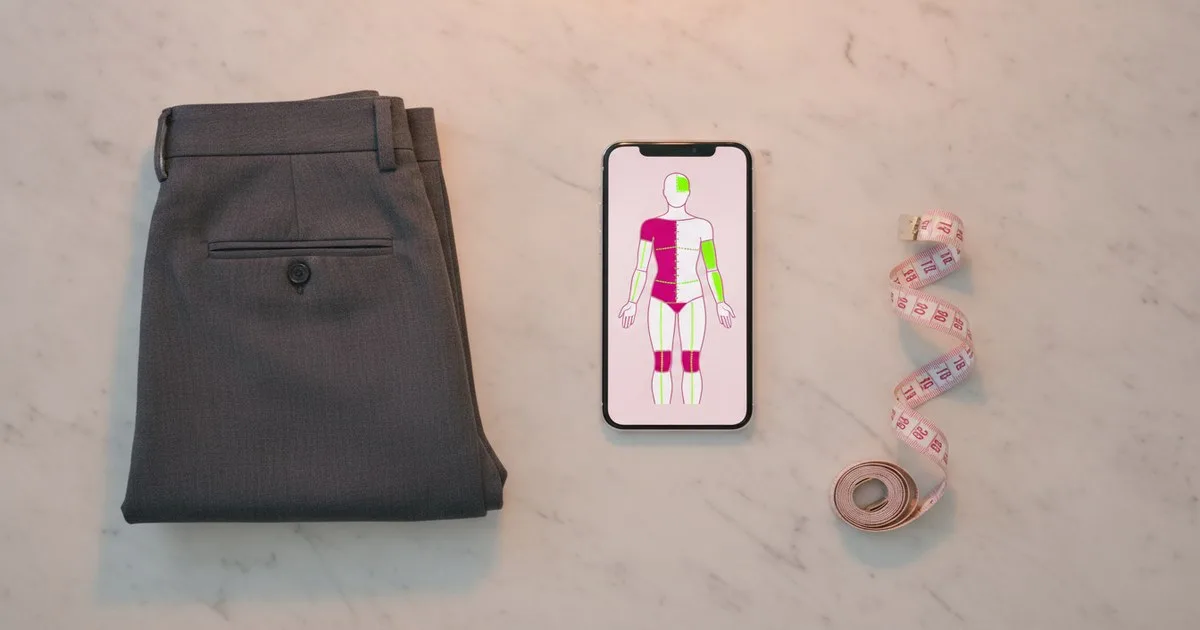
Size-related returns are one of the most expensive problems in fashion e-commerce, and two distinct technology approaches now compete to solve them: probabilistic fit-recommendation engines that learn from purchase and return history, and smartphone body-scanning tools that extract physical measurements from a pair of photos. Both can reduce the number of parcels coming back. They do it in fundamentally different ways, and the right choice depends on your customer base, your catalogue, and how much integration work your team can absorb.
Key takeaways
- Fit recommendation engines work with data you already have—purchase history, return reasons, stated preferences—and require no action from the shopper beyond browsing.
- Body scanning extracts dozens of measurements from two smartphone photos and can achieve sub-centimetre accuracy, but it asks customers to opt in and take those photos.
- Zalando's Size & Fit AI, which combines both approaches, reduced size-related returns by more than 8% across its platform.
- The two approaches are not mutually exclusive: many retailers use behavioural signals as the default and body measurements as an optional upgrade.
- Infrastructure cost and data-privacy obligations differ sharply between the two, and those differences often decide the choice before accuracy does.
What problem are we actually solving?
Returns driven by fit and size are not a niche inconvenience. For most multi-brand fashion retailers, they represent the single largest category of returned items—and unlike returns driven by quality disappointment, they are structurally predictable. A shopper who consistently orders a medium in one brand and a large in another is not being careless; she is navigating a system that gives her no reliable way to compare. The technology question is: which signal, collected at which point in the journey, gives you the best prediction of what will fit?
How do fit recommendation engines work?
Fit recommendation engines are probabilistic systems. They do not measure a body; they infer a likely size from a pattern of behaviour. The inputs typically include:
- Purchase history — what sizes the customer has bought across which brands
- Return data — whether items came back and, critically, the stated reason ("too small", "too large", "fit as expected")
- Self-reported preferences — a customer profile where shoppers note their usual size in a reference brand
- Garment attributes — cut, fabric stretch, silhouette data from the product itself
A Bayesian model published by researchers working on large-scale fashion e-commerce data—SizeFlags, presented at ACM SIGKDD—demonstrated that weakly annotated return signals, combined with computer-vision intelligence about garment construction, can be combined into a probabilistic recommendation with measurable impact in A/B testing. The key insight is that you do not need a customer to tell you their measurements if you have enough signal about what they have already kept.
What this means in practice: fit engines are low-friction for the shopper. A returning customer sees a size recommendation the moment she lands on a product page, with no extra steps required. For a retailer with a large, loyal customer base and years of purchase data, this is a significant advantage.
Where it struggles: cold-start customers—first-time visitors with no history—receive generic or lightly personalised recommendations. The engine is also only as good as the return-reason data it ingests; if your returns portal offers vague categories, the signal degrades.
True Fit is one of the best-known providers in this category, operating a network that aggregates anonymised fit and preference data across a large number of partner brands and retailers. Its platform sits on product pages, search results, and homepage surfaces, and it has been expanding into agentic shopping infrastructure—positioning fit and size knowledge as a layer that AI assistants and marketplace stacks can call directly.
Fit Finder, the size recommendation tool acquired by Snap Inc. in 2021 and now part of Snap's commerce and AR stack, operates on a similar behavioural-signal model, folded into Snap's broader shopping capabilities.
Bold Metrics takes a complementary approach: it builds a digital twin for each shopper, mapping more than 50 body measurements inferred from a short set of questions, then uses those measurements to power its Smart Size Chart and Virtual Sizer products. It sits between pure behavioural engines and full body scanning—using structured self-report rather than image capture.
How does smartphone body scanning work?
Body scanning apps ask the customer to take two photos—typically front and side—wearing fitted clothing. Computer vision and machine learning then extract body measurements: circumferences, heights, widths, and in some implementations, estimates of body composition.
A review of mobile body scanning applications published in the Journal of the Textile Institute found that the scanning process can be completed in as little as 30 seconds and as long as 5 minutes, and that modern smartphone-based systems can capture distances, girths, heights, widths, surface area, and circumferences with meaningful accuracy from just a front and side image.
The outputs are then matched against a brand's size chart or a garment's graded measurements to produce a specific size recommendation—or, with a more sophisticated integration, a prediction of how a particular cut will sit on that body.
What this means in practice: body scanning is more accurate for shoppers whose body proportions fall outside the standard size assumptions baked into a brand's grading. A customer who is tall with a narrow shoulder but a fuller hip, for example, benefits far more from a measurement-based recommendation than from a behavioural one, because no amount of purchase history cleanly captures that combination across brands.
Where it struggles: opt-in rates. Asking a shopper to take two photos of themselves in fitted clothing is a meaningful ask. Privacy concerns, lighting requirements, and the simple friction of the extra step all reduce the share of customers who complete the scan. The recommendation is only as good as the photo quality, and edge cases—unusual postures, loose clothing, poor contrast—can introduce error.
3DLOOK ships FitXpress, which extracts more than 80 body measurements from two smartphone photos in under 45 seconds. The company has moved its primary focus toward health, fitness, and wellness platforms—GLP-1 adherence programmes, telehealth, and nutrition apps—where accurate body composition tracking is the core use case. Its technology is available via API and SDK, meaning fashion retailers can integrate measurement extraction into their own apps or product pages rather than redirecting to a separate scanning experience.
Zalando has built its own version of this hybrid. Since mid-2023, customers can receive personalised size recommendations based on body measurements taken from two smartphone photos, layered on top of the behavioural signals the platform has always collected.
Comparing the two approaches
| Fit recommendation engine | Smartphone body scanning | |
|---|---|---|
| What it is | Probabilistic model trained on purchase history, return data, and garment attributes | Computer vision system that extracts body measurements from two photos |
| Best for | Retailers with large, returning customer bases and rich return-reason data | Brands whose shoppers have atypical proportions, or categories where fit is highly body-specific (tailoring, performance, swimwear) |
| Customer friction | Very low — recommendation appears automatically | Medium — requires opt-in and two photos |
| Cold-start problem | Yes — limited accuracy for new customers | No — measurements work regardless of purchase history |
| Data privacy surface | Purchase and behavioural data; standard e-commerce data stack | Body image data; requires explicit consent and careful data handling |
| Integration complexity | API or widget on product page; relatively fast to deploy | SDK or API integration; may require UX changes to the purchase flow |
| Accuracy ceiling | Bounded by the quality of return-reason data and catalogue metadata | Bounded by photo quality and the accuracy of brand size charts |
What does the evidence say about return reduction?
Hard, independently audited figures are rare in this space—vendors typically report their own A/B test results, which are not always comparable across contexts. The most transparent public data point comes from Zalando, which reported in its full-year 2025 results that its Size & Fit AI, using real body measurements from over a million customers, helped shoppers avoid size-related returns by more than 8%. That system combines behavioural signals with optional body measurement capture—it is not a single-method result.
The SizeFlags research demonstrated strong impact in large-scale A/B testing for a probabilistic Bayesian approach, but the specific return-rate figures are not publicly disclosed in the paper.
What both data points suggest is that the ceiling for either approach in isolation is lower than the ceiling for a combined system. Behavioural signals cover the majority of returning customers cheaply; body measurements close the gap for new customers and for fit-sensitive categories.
What is still unsolved?
Several problems remain genuinely open:
Garment-level measurement data is inconsistent. A size recommendation is only as accurate as the measurements attached to the garment it is recommending. Many brands still publish only nominal size labels on product pages, not actual garment measurements. Until that data is standardised and machine-readable at scale, even the best fit engine is working with incomplete information.
Cross-brand calibration is hard. A customer's "medium" in one brand may correspond to a "large" in another. Fit engines that operate across a multi-brand marketplace have more data to work with, but they also inherit more noise. Body scanning sidesteps this by working in absolute measurements—but only if the brand's size chart is itself accurate.
Opt-in rates for scanning remain low. The academic and industry consensus is that a meaningful share of shoppers will not complete a body scan, which means any scanning-only strategy leaves a large portion of your customer base on a less accurate recommendation. Hybrid architectures—scan where you can, infer where you cannot—are the practical answer, but they require more engineering.
Return reasons are underreported. Brands we speak to consistently note that many customers return items without selecting a specific reason, or select a vague category. This degrades the feedback loop for behavioural engines. Improving return-reason capture—through better UX, smarter prompts, or post-return surveys—is as important as the recommendation algorithm itself.
Which approach suits which retail context?
There is no universal answer, but the decision tree is reasonably clear:
- Large multi-brand marketplace with a loyal returning customer base: start with a fit recommendation engine. The data you already have is your biggest asset. Add optional body scanning as an upgrade path for new customers.
- Single-brand retailer in a fit-sensitive category (tailoring, performance, swimwear, denim): body scanning or a hybrid approach is worth the opt-in friction. The cost of a wrong-fit return in these categories is high, and the customer is often motivated enough to complete a scan.
- Brand with a young or predominantly first-time customer base: behavioural signals are thin; body scanning or a structured self-report tool like Bold Metrics' digital-twin approach gives you something to work with before history accumulates.
- Brand selling through third-party marketplaces: you may not control the product page experience. In this case, fit recommendation infrastructure that can be called via API—like True Fit's agentic layer—is more deployable than a scanning flow that requires a custom UX.
FAQ
What is a fit recommendation engine? A fit recommendation engine is a machine-learning system that predicts which size a shopper should order based on their purchase history, return behaviour, stated preferences, and garment attributes. It does not measure the body directly; it infers a likely fit from patterns in existing data.
How accurate is smartphone body scanning for clothing size? Modern smartphone scanning systems can extract a wide range of body measurements from two photos in under a minute. Accuracy depends on photo quality, clothing fit during the scan, and the accuracy of the brand's own size charts. It is generally more precise than behavioural inference for shoppers with atypical proportions.
Do I need body scanning if I already have a fit recommendation tool? Not necessarily. Fit recommendation engines perform well for returning customers with purchase history. Body scanning adds most value for new customers and in categories where fit is highly body-specific. A hybrid approach—behavioural signals as the default, scanning as an opt-in upgrade—tends to outperform either method alone.
What return rate reduction can I realistically expect? Publicly available figures vary widely and depend on the category, customer base, and baseline return rate. A combined behavioural and body-measurement approach at scale has been associated with reductions in size-related returns of around 8% or more, but results in a specific retail context will differ.
What data privacy obligations come with body scanning? Body image data is sensitive personal data in most jurisdictions. Collecting it requires explicit informed consent, clear retention and deletion policies, and careful handling under applicable data protection law. Retailers should treat body scan data as a higher-risk category than standard purchase data and involve legal counsel before deployment.
Why do some customers refuse to use body scanning tools? Privacy concerns, discomfort with sharing body images, and the friction of the extra step are the most commonly cited barriers. Opt-in rates improve when the benefit is clearly communicated, the process is fast, and customers are confident their images will not be stored or shared.
Further reading
- SizeFlags: Reducing Size and Fit Related Returns in Fashion E-Commerce
- Mobile 3D body scanning applications: a review
- How Zalando leverages technology to help customers find the right size