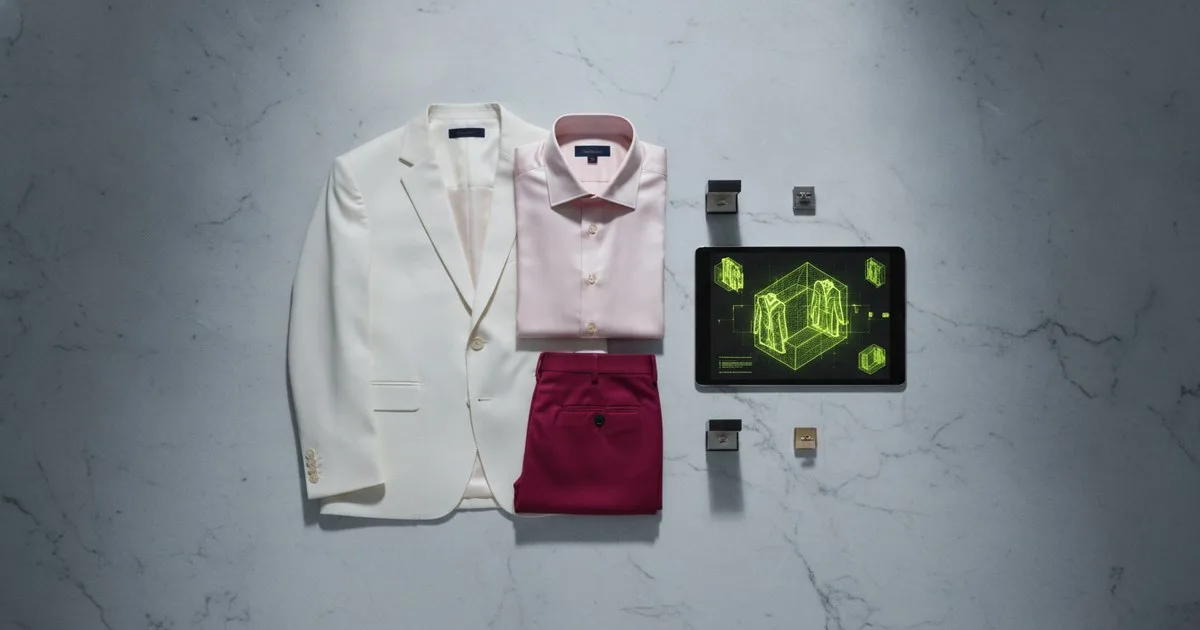
Hugo Boss has one of the most thoroughly documented digital product creation programmes in premium fashion — and almost all of it is sitting in public filings. The brand's annual reports, investor communications and press releases trace a consistent arc: from early 3D pilots to a confirmed target of developing more than 90% of products digitally. What follows draws exclusively on those verified sources, so you know exactly what has been announced, what has been achieved, and what remains aspirational.
Key takeaways
- Hugo Boss confirmed that around 75% of its products were digitally developed in fiscal year 2025, up from around 65% in 2024.
- The brand set a public target of more than 90% digital development, with continued expansion expected in coming years.
- A fully digital collection — covering apparel, footwear and accessories — was presented to wholesale buyers as early as the Pre-Fall 2021 season.
- AI-driven demand forecasting and trend analysis are now described as inputs to the product development process in the company's own management report.
- The programme sits inside a broader strategic priority the brand calls 'Lead in Digital', which spans design, sampling, ordering and distribution.
What does 'digital product creation' actually mean for a brand like Hugo Boss?
The term covers everything from the first sketch to the approved sample — done on screen rather than in a physical atelier. In practice that means 3D garment simulation replacing physical prototypes, digital fabric libraries substituting for physical swatches, and AI tools informing which silhouettes and colourways are worth developing in the first place.
For a brand operating at the scale of Hugo Boss — with two labels (BOSS and HUGO), global wholesale relationships, and its own retail and e-commerce channels — the efficiency case is straightforward: fewer physical samples means shorter development calendars, lower material waste, and faster feedback loops with buyers.
The harder question is how far along any brand actually is. Marketing language about 'digital-first' is common; confirmed percentages in audited annual reports are rarer. Hugo Boss publishes both.
What do the annual reports actually confirm about 3D sampling?
The 2025 management report states that around 75% of products were digitally developed in fiscal year 2025, up from around 65% in 2024, with continued expansion expected. The same report describes the process as beginning with a creative idea that is transformed into specific designs and collections, drawing on sell-through rates from previous seasons, wholesale partner feedback, and AI-driven insights from digital demand forecasting and trend analysis.
The 2023 report provides the earlier trajectory: the proportion of digitally developed products reached around 65% in fiscal year 2023, up from around 55% in 2022. That same filing describes the goal of developing more than 90% of products digitally by 2025, and credits progress in immersive 3D simulations and the expansion of digital development to additional product groups.
The consistent year-on-year reporting — with specific percentages, not ranges — is notable. Many brands describe digital ambitions without attaching measurable milestones to them.
When did Hugo Boss first present a fully digital collection?
The clearest milestone in the public record is the Pre-Fall 2021 collection, announced in October 2020, which the company described as the first collection developed digitally from start to finish. The 105-piece collection spanned apparel, footwear and accessories. According to the press release, product development was completely digital — from initial sketches through fabric and colour selection, prototyping and the finished collection. Wholesale buyers could place orders digitally from the announcement date.
That milestone matters because it predates the current wave of AI-in-fashion coverage by several years. The infrastructure for digital sampling was being built and tested at scale before it became an industry talking point.
What role does AI play in Hugo Boss product development today?
The 2025 annual report is specific on this point: AI-driven insights are described as inputs to demand forecasting and trend analysis, and those outputs feed into the product development process at the creative stage. The report does not detail the underlying tools or vendors, but it frames AI as part of how the brand decides what to develop — not just how it renders or presents finished designs.
This is a meaningful distinction. AI in design visualisation (generating mood boards or colourway options) is relatively straightforward to implement. AI that influences which products actually enter development — by reading sell-through data, consumer signals and trend patterns — sits closer to the core commercial decision-making of a fashion business.
Brands and analysts who follow this space, including coverage from The Business of Fashion, have noted that the most durable AI applications in fashion are those connected to real demand data rather than generative aesthetics alone. Hugo Boss's filings suggest the brand is building toward the former.
How does PLM connect to the digital development programme?
The annual reports do not name specific PLM vendors, but the logic of a programme at this scale requires product lifecycle management infrastructure to function. Moving 75% of a global collection through digital development means managing thousands of digital assets — tech packs, 3D files, material specifications, approval workflows — across design, sourcing, and production teams in multiple countries.
PLM platforms purpose-built for fashion, such as Centric PLM (part of Dassault Systèmes), provide the connective tissue between 3D design tools and downstream production. Whether Hugo Boss uses Centric or another solution is not confirmed in the public record, but the category of tooling is a structural requirement for any programme of this complexity.
Similarly, 3D simulation platforms such as Browzwear — whose VStitcher software enables physics-based garment simulation, AI-assisted fit validation, and direct connectivity to PLM and ERP systems — represent the kind of infrastructure a brand would need to move the majority of its collection through digital sampling. Browzwear's platform also now supports AI-generated on-model imagery, which compresses the path from approved 3D sample to buyer-facing commercial asset.
What is the 'Lead in Digital' strategy, and where does product creation sit within it?
Hugo Boss has described 'Lead in Digital' as a strategic priority spanning multiple parts of the business — not only product development but also digital commerce, wholesale ordering tools, and consumer-facing experiences. The digital product creation programme is one pillar of that broader commitment.
The brand is also subject to a pending unsolicited takeover offer from Frasers Group, its largest shareholder, which adds a layer of corporate uncertainty to medium-term strategy. How that process resolves will determine whether the current digital investment trajectory continues under the same leadership and priorities.
What has Hugo Boss confirmed versus what remains aspirational?
It is worth separating what the filings confirm from what is still a stated goal.
Confirmed in public filings:
- Around 75% digital development rate in fiscal year 2025
- A year-on-year improvement from approximately 55% in 2022 to 75% in 2025
- A fully digital collection presented to wholesale buyers for the Pre-Fall 2021 season
- AI-driven demand forecasting and trend analysis as inputs to the development process
- A stated goal of more than 90% digital development
Not confirmed in public filings:
- Specific 3D software vendors in use
- PLM platform names or integration details
- Headcount dedicated to digital product creation
- Cost savings or time-to-market improvements attributed to the programme
The gap between what is confirmed and what is commonly assumed matters for anyone using Hugo Boss as a benchmark. The percentages are real and audited; the vendor stack and internal economics are not public.
What does this mean for the wider industry?
Hugo Boss's trajectory — from roughly half its collection developed digitally in 2022 to three-quarters in 2025, with a 90%-plus target on the horizon — gives the industry a rare, quantified data point. Most brands describe digital transformation in qualitative terms. Having a confirmed percentage in an annual report creates accountability and a basis for comparison.
For competing brand technology teams, the implication is that a sustained, multi-year investment in 3D simulation infrastructure and AI-driven forecasting can produce measurable results at scale. The Pre-Fall 2021 milestone also suggests that the operational learning curve — training design and development teams, building digital fabric libraries, integrating approval workflows — takes several seasons to work through before the percentages start moving quickly.
For investors, the digital product creation programme is one indicator of operational efficiency potential: fewer physical samples, faster buyer approvals, and AI-informed range decisions all point toward lower development costs and better sell-through rates over time. Whether those gains are materialising in the P&L is a question the filings do not yet answer directly.
FAQ
What percentage of Hugo Boss products are developed digitally?
Hugo Boss confirmed in its 2025 annual report that around 75% of products were digitally developed in fiscal year 2025, up from around 65% in 2024 and approximately 55% in 2022. The brand has set a target of more than 90% digital development.
Does Hugo Boss use AI in product development?
Yes. The 2025 management report describes AI-driven demand forecasting and trend analysis as inputs to the product development process, influencing which designs and collections are taken forward from the creative stage.
When did Hugo Boss launch its first fully digital collection?
The Pre-Fall 2021 collection, announced in October 2020, was described by the company as the first collection developed entirely digitally — covering apparel, footwear and accessories across 105 pieces.
What is Hugo Boss's 'Lead in Digital' strategy?
'Lead in Digital' is Hugo Boss's stated strategic priority for digital transformation across the business, including product development, digital commerce and wholesale ordering tools. Digital product creation is one component of this broader programme.
Does Hugo Boss name its 3D or PLM software vendors in its annual reports?
No. The annual reports confirm the digital development percentages and describe the process at a high level, but do not name specific software vendors or technology partners in the product development sections.
What is the corporate context for Hugo Boss's digital strategy right now?
Hugo Boss is currently the subject of a pending unsolicited takeover offer from Frasers Group, its largest shareholder. How that process resolves may affect the continuity of the current digital investment programme.
Further reading
- Product Development and Innovation — Hugo Boss Annual Report 2025
- Product Development and Innovation — Hugo Boss Annual Report 2023
- Hugo Boss digitalizes collection development and distribution (press release)