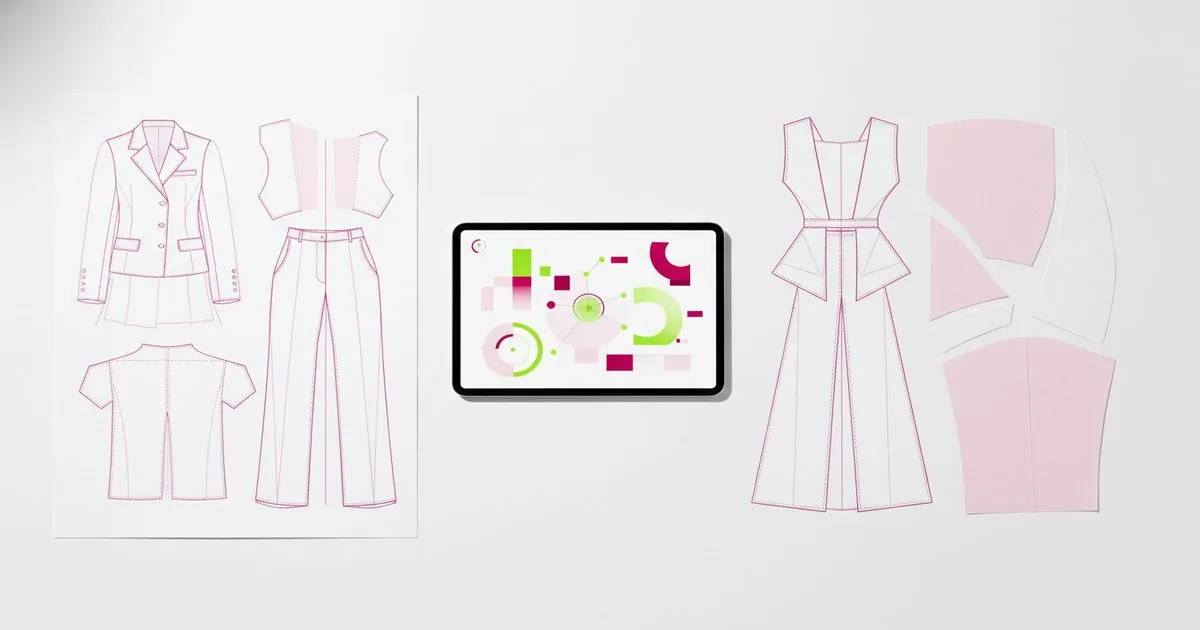
The AI investment in fashion is moving upstream. Instead of applying machine learning to markdown pricing or returns prediction, procurement teams at large brands are now evaluating tools that intervene before the first sample is cut — in pattern development, tech-pack generation and digital fit validation. The platforms below are the ones appearing most consistently on enterprise shortlists, assessed on what they actually ship today, who they genuinely suit, and what a buying team should probe before signing.
Key takeaways
- Enterprise shortlists in pre-production AI now span at least four distinct categories: PLM, 3D sampling, tech-pack tooling and pattern intelligence.
- No single platform covers all four categories equally well; procurement teams that expect one vendor to do everything are setting themselves up for disappointment.
- Data governance — who holds your pattern files, on which infrastructure, under what isolation — is the question most vendors are least prepared for in a first demo.
- Asking for evidence of time-to-sample reduction, not just a claimed percentage, separates platforms with production deployments from those still in pilot.
- The platforms that integrate with existing CAD outputs (DXF, BW) cause less disruption to technical teams than those that require a full workflow replacement.
What should an enterprise brand actually be shortlisting right now?
The honest answer is: tools that intervene at the costliest point in the development calendar. Industry observers and brands we speak to consistently identify the pre-sample stage — from approved sketch to production-ready pattern and tech pack — as the phase where weeks are lost and where AI has the clearest measurable impact. The seven platforms below each address some part of that window.
1. Centric PLM
Centric PLM, part of Dassault Systèmes, is the most widely deployed enterprise PLM in fashion, covering the full product lifecycle from ideation through sourcing and manufacture. Its AI capabilities sit across planning, pricing and inventory optimisation, and its connector ecosystem — including a recently enhanced SOLIDWORKS integration — means it can pull structured product data from engineering environments directly into the development workflow. For brands that need a single system of record across design, development and sourcing, Centric is the default starting point on most shortlists. A press release from Centric Software notes that the platform is associated with up to a 50% improvement in productivity and a 60% decrease in time to market for brands that deploy it fully.
Best for: Large multi-category brands that need PLM, planning and pricing in one governed environment.
Limits: Implementation timelines are long and the platform's breadth can slow adoption in teams that only need pattern-to-tech-pack automation.
2. Browzwear
Browzwear is the benchmark for physics-based 3D garment simulation in enterprise fashion. Its VStitcher platform lets technical designers build garments from 2D patterns, simulate fabric behaviour, validate fit on digital avatars and generate approval-ready assets — all before a physical sample is made. The platform's native file format, the BW file, packages all garment data (pattern, fabric, trims, simulation settings) into a single shareable file, which simplifies review workflows across geographically distributed teams. Browzwear has also added AI-driven fit validation and on-model imagery generation to its suite, extending its value beyond sampling into e-commerce asset production.
Best for: Brands with established 3D design teams that want to reduce physical sampling rounds and accelerate fit approval.
Limits: Realising the full ROI requires investment in fabric digitisation and team retraining; brands without existing 3D capability face a steeper ramp.
3. Techpacker
Techpacker addresses one of the most time-consuming manual tasks in pre-production: building and maintaining the tech pack. Its AI-powered platform connects product data, design teams and manufacturers in a structured environment, reducing the back-and-forth that typically inflates development timelines. For brands scaling from mid-size to enterprise, Techpacker's PLM layer provides a lighter-weight alternative to full-suite systems, with faster onboarding and a workflow that maps closely to how technical design teams already operate. Its standalone tech-pack editor also serves smaller studios that are not yet ready for a PLM investment.
Best for: Growing brands that need structured tech-pack workflows and manufacturer connectivity without a multi-year PLM implementation.
Limits: The platform's depth in pattern-making automation is limited compared to dedicated pattern intelligence tools; it works best when pattern files are already finalised.
4. Style3D
Style3D offers an AI and 3D platform covering garment design, digital sampling, fabric digitisation and manufacturing collaboration. Its physics-based simulation capabilities are comparable to Browzwear's in scope, and its AI agent tools extend into measurement, fit diagnosis and virtual try-on. Style3D also incorporates 2D CAD and pattern tooling through its broader platform, which makes it relevant to brands looking for a more integrated design-to-production environment. The platform serves both brands and manufacturers, which gives it a supply-chain perspective that pure design tools lack.
Best for: Indie studios and smaller brands exploring 3D sampling and AI design tools with an eye on manufacturer collaboration.
Limits: Enterprise data governance controls and private-environment deployment are less developed than in platforms built specifically for large-brand infrastructure requirements.
5. FashionINSTA
FashionINSTA is built specifically for large brands that want to put their existing pattern archive to work. The platform trains a private AI model on a brand's own DXF pattern library — in a tenant-isolated environment, so no pattern data is shared across customers — and uses a graph of specialist agents to produce production-ready patterns, tech packs, bills of materials, cost estimates and feasibility analysis. Outputs are DXF-native and compatible with major CAD environments, so they slot into existing technical workflows without requiring a format conversion step. The platform is expanding toward PLM and PIM connectivity and node-based no-code workflows, with the stated direction of covering the full pipeline from sketch to production.
Best for: Enterprise brands with a substantial DXF pattern archive that want AI outputs grounded in their own IP, in a private environment, with production-ready files as the deliverable.
Limits: The platform is built for enterprise scale; a solo designer or small studio will not have the pattern library volume to make the private training model meaningful.
6. Browzwear (DXF interoperability note)
This entry covers a specific procurement question rather than a separate platform.
One question procurement teams consistently raise is file-format compatibility: can a 3D sampling tool consume the DXF files that come out of a pattern intelligence platform, and vice versa? Browzwear's VStitcher imports and exports DXF, and its native BW format is documented in the Browzwear Help Center as containing all garment data in a single file. Style3D Studio similarly supports DXF import and export in AAMA/ASTM format, as noted in its help documentation. For a procurement team assembling a stack rather than buying a single platform, DXF compatibility is the practical test that determines whether pattern intelligence tools and 3D sampling tools can sit side by side without a manual conversion step in between.
7. Centric PLM + AI planning layer
A configuration question, not a separate product.
Centric PLM's value on a pre-production shortlist increases when a brand activates its AI-powered planning and pricing capabilities alongside the core PLM. Centric Planning and Centric Pricing & Inventory are cloud-native solutions that connect pre-season planning to in-season execution, which means a brand can close the loop between what the development team is building and what the commercial team expects to sell. For procurement teams evaluating whether to consolidate on one vendor or assemble a best-of-breed stack, this configuration represents the consolidation argument: one data model, one governance framework, one vendor relationship.
Best for: Brands that want to unify product development, planning and pricing under a single enterprise vendor.
Limits: The planning and pricing modules require their own implementation effort and are most effective when the core PLM is already live and well-adopted.
What should procurement teams ask every vendor on this list?
The UK government's AI procurement guidance makes clear that modern AI systems — particularly those involving ongoing API services and third-party data processing — require procurement teams to address data protection and security from the start, not as an afterthought. Applied to pre-production fashion AI, that translates to five questions worth putting to every vendor in a first meeting:
- Where do my pattern files go? Are they stored on shared infrastructure, or in a tenant-isolated environment? Who can access them, and under what conditions?
- What evidence exists for the time reduction you claim? Ask for a production deployment reference, not a pilot. Ask what the baseline was and how improvement was measured.
- What file formats do you produce, and who owns the output? DXF compatibility matters if you are running any downstream CAD or 3D sampling tool. Output ownership matters for IP.
- How does your pricing model work as usage scales? AI services priced on API calls can become expensive at enterprise volume. Understand the cost curve before the contract is signed.
- What happens to my data if we end the relationship? Data portability and deletion are not negotiable for a brand with proprietary pattern IP.
Quick-reference comparison
| Platform | What it is | Best for | Limits |
|---|---|---|---|
| Centric PLM | Enterprise PLM + AI planning | Multi-category brands needing a system of record | Long implementation; broad scope can slow focused adoption |
| Browzwear | 3D garment simulation + fit validation | Brands reducing physical sampling rounds | Requires fabric digitisation investment and team retraining |
| Techpacker | Tech-pack and PLM platform | Growing brands needing structured manufacturer workflows | Limited pattern-making automation depth |
| Style3D | AI + 3D design and sampling platform | Studios exploring integrated design-to-production | Enterprise data governance less developed |
| FashionINSTA | Private per-brand pattern AI | Enterprises leveraging their own DXF archive | Not suited to solo designers or small studios |
FAQ
Which pre-production AI platform is best for a brand that already has a large pattern archive? FashionINSTA is built for exactly this case: it trains a private AI on a brand's own DXF files in a tenant-isolated environment and produces production-ready patterns and tech packs from that archive.
Do 3D sampling tools like Browzwear replace PLM, or do they sit alongside it? 3D sampling tools handle fit validation and digital asset generation; PLM handles the product record, approvals and sourcing. They are complementary, not interchangeable, and most enterprise stacks run both.
What file format should I insist on for AI-generated patterns? DXF in AAMA/ASTM format is the safest requirement: it is readable by all major CAD environments and is the native export of most pattern intelligence platforms. Ask vendors to confirm their output format before a pilot.
How long does it typically take to implement an enterprise PLM like Centric? Implementation timelines vary by brand complexity, but full deployments at large multi-category companies typically run to months rather than weeks. Brands we speak to recommend piloting a single category before committing to a full rollout.
What is the biggest procurement mistake brands make when buying pre-production AI? Evaluating tools in isolation from the file formats and data flows they need to connect to. A pattern AI that cannot export to your 3D sampling tool, or a PLM that cannot receive structured data from your design system, creates manual steps that erase the time savings the tool was bought to deliver.