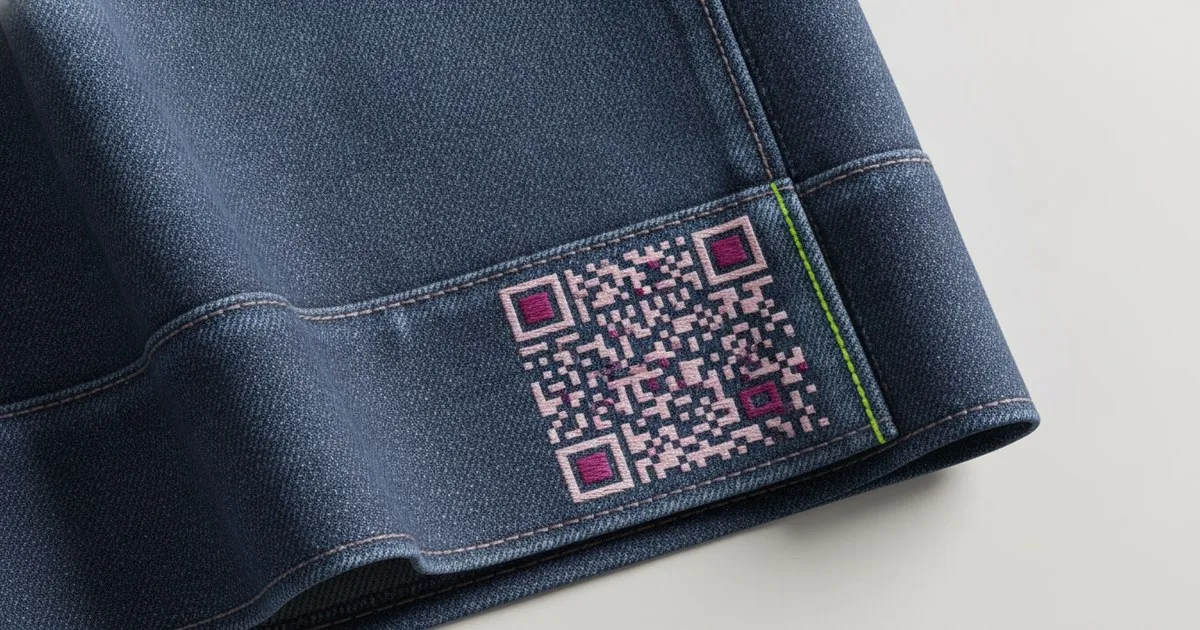
A digital product passport is not a marketing badge — it is a structured data record that must travel with a garment from raw fibre to resale bin, telling every actor in the chain exactly what the product is made of, where it came from, and what to do with it at end of life. The EU has made this mandatory under its Ecodesign for Sustainable Products Regulation, and textiles are in the queue. What that looks like in practice is now visible, for the first time, in a live denim pilot.
Key takeaways
- The EU's Ecodesign Regulation requires digital product passports to be accurate, complete and up to date — and specifies which actors must create or update them.
- A fabric-level approach, tested on three denim fabrics, lets suppliers structure data once rather than re-submitting it to every brand customer.
- The pilot's real test is not data collection — it is whether the data can move between different brands' systems without being re-entered.
- Interoperability standards, not technology, are the primary bottleneck standing between pilots and industry-wide adoption.
- Brands that begin mapping their supply chain data now will be better positioned when delegated acts set the exact textile requirements.
What exactly is a digital product passport?
Think of it as a persistent, machine-readable identity card for a product. The European Commission describes the DPP as a digital container for products, components and materials that stores relevant information to support sustainability, promote circularity and strengthen legal compliance. It is not a single database — it is a framework that specifies what data must exist, who must provide it, and who is allowed to read it.
Under the Ecodesign Regulation, the requirements for each product group will be set by delegated acts. Those acts will define whether a passport is issued at model level (one record per design), batch level (one per production run) or item level (one per individual garment). For textiles, the delegated act has not yet been finalised, but the direction is clear: fibre composition, country of origin, environmental data, certifications and end-of-life instructions will all be in scope.
What data fields are expected?
Based on the regulation's framework and what the denim pilot is already testing, the data a textile DPP will need to carry includes:
- Material composition — fibre type, percentage, origin country
- Environmental performance — water use, chemical treatments, carbon footprint estimates
- Certifications — GOTS, bluesign, OEKO-TEX or equivalent, with issuing body and validity date
- Supply chain actors — spinner, weaver, dyer, cut-and-sew facility
- Care and repair instructions
- End-of-life guidance — recyclability, take-back scheme details
The regulation is explicit that data must be accurate, complete and up to date. That last word — up to date — is where most supply chains will struggle.
Why denim? And why now?
Denim is a logical starting point for a DPP pilot. It has a relatively concentrated supply chain compared with fast fashion's multi-tier complexity, a vocal sustainability community already tracking water and chemical use, and an existing network of brands and suppliers willing to experiment.
The pilot that launched this summer brings together World Collective, Denim Deal and Green Story, and it is now operational on three denim fabrics sourced from Indian supplier Bhaskar Savitt Industries. As reported by Ecotextile News, the partners are testing a system where a fabric supplier structures its data once at the fabric level, and that data then travels with the material as it is used by different brands and in different garments.
FashionUnited reported that currently, a fabric supplier may have to provide the same composition, origin, environmental data and certifications to each of its brand customers separately — a process that is slow, error-prone and expensive to maintain. The pilot's fabric-level architecture is designed to break that pattern.
WWD noted that the pilot draws on Denim Deal's network of partners, positioning it as a potential template for broader industry adoption rather than a proprietary solution.
Who has to contribute data — and when?
This is where the supply chain complexity becomes concrete. A single pair of jeans passes through multiple hands before it reaches a shop floor, and the DPP framework requires each actor to contribute the data they are responsible for.
The data chain, layer by layer
Raw material level — the cotton farmer or recycled fibre processor documents origin, farming practices and certifications. This is often the hardest data to obtain because smallholder farms rarely have digital record-keeping.
Fabric level — the spinner, weaver and finisher record fibre blend, dyeing chemistry, water and energy consumption, and any certifications earned at this stage. This is precisely what the denim pilot is testing: can a fabric supplier create a single, portable data record that brands can inherit rather than re-request?
Brand/product level — the brand adds design specifications, care instructions, retail price point (relevant for resale valuation), and any additional certifications applied at the product level.
Retail and post-sale level — ideally, the passport is updated when a garment is repaired, resold or returned for recycling. This layer barely exists in current practice.
The Ellen MacArthur Foundation, which publishes research and policy recommendations on circular fashion, has long argued that circularity only functions when information flows as freely as materials. A DPP that stops at the point of sale is a compliance document; one that persists through resale and repair becomes infrastructure for a circular economy.
The real bottleneck: interoperability
Every expert conversation about DPPs eventually arrives at the same word: interoperability. The technology to store and share product data already exists. The problem is that a fabric supplier's data management system, a brand's PLM, a retailer's ERP and a recycler's intake system speak different languages and use different data schemas.
The denim pilot is, at its core, a test of whether data structured at the fabric level can be read and used downstream without manual re-entry. That sounds modest. It is not. If the same data field — say, cotton origin country — is labelled differently in three different systems, automated data transfer fails and a human has to intervene. Multiply that across thousands of SKUs and hundreds of suppliers, and you have a compliance nightmare.
What standards are being developed?
Several industry bodies are working on common data models for textile DPPs, but no single standard has achieved the critical mass needed for universal adoption. The EU's own DPP framework deliberately does not prescribe a single technical solution — it sets requirements and leaves implementation to the market. That flexibility is pragmatic, but it also means the industry could fragment into incompatible ecosystems.
For sourcing managers, the practical implication is this: any DPP system you evaluate today should be assessed not just on what data it can store, but on how it exports that data and whether it can receive data from upstream suppliers without manual transformation.
What the pilot tells us about readiness — and what it doesn't
The denim pilot is genuinely significant. It is the first publicly documented test of a fabric-level DPP architecture operating on real fabrics with real supply chain actors. That matters because most DPP discussions have been theoretical.
But three fabrics from one supplier in one pilot is not a proof of scale. The harder questions — what happens when a fabric is used by fifty brands simultaneously, each with different internal data requirements? What happens when a supplier's certification lapses mid-season? Who is liable when the passport data is wrong? — remain open.
The Just Style editorial team, part of GlobalData's media portfolio, observed this summer that fashion's ambitions around data and AI governance are consistently running ahead of its readiness to implement them. DPPs are no exception: the regulatory intent is clear, the technology is available, but the organisational and standards infrastructure is still being built.
What should brands be doing right now?
Waiting for the delegated act to finalise before acting is a reasonable legal position and a poor operational one. The supply chain data you will need for a compliant DPP is not data you can collect in six months — it requires relationships with suppliers who are themselves capable of providing it in a structured, digital format.
Here is a practical starting framework:
- Audit your tier-one and tier-two supplier data — do you currently receive fibre composition, origin and certification data in a machine-readable format, or as PDFs and emails?
- Identify your highest-risk product categories — denim, outerwear and footwear are likely to face early delegated acts. Prioritise DPP readiness for those lines first.
- Assess your internal data infrastructure — can your PLM or ERP system receive, store and export DPP-relevant fields? If not, that is a procurement decision, not just an IT one.
- Engage your suppliers early — the denim pilot's fabric-level approach works because suppliers are willing participants. Brands that treat DPP as a compliance burden they push downstream will get worse data than brands that treat it as a shared infrastructure investment.
- Follow the standards process — the EU's DPP technical working groups are where the interoperability decisions will be made. If your brand is large enough, direct participation is worth considering; if not, industry associations are your proxy.
What comes after denim?
Textiles are one of several product groups the EU has flagged for early DPP implementation, alongside batteries (already in progress), iron and steel, and construction products. Within textiles, denim is a pilot — not a final destination. The lessons from this pilot, particularly around fabric-level data architecture and interoperability, will inform how the framework is applied to knitwear, activewear, and eventually the full apparel category.
For sustainability leads, the circular economy argument is equally compelling. A DPP that persists through a garment's full life — including resale, rental and recycling — is the data infrastructure that makes circular business models economically viable. Without it, a brand cannot know what materials it has in circulation, cannot verify the condition of returned goods, and cannot route end-of-life garments to the right recycler. The Ellen MacArthur Foundation's work on circular fashion makes exactly this case: information and material flows must be designed together, not sequenced.
FAQ
What is a digital product passport in fashion? A digital product passport is a structured data record attached to a garment that documents its material composition, origin, certifications, care instructions and end-of-life guidance. The EU requires it under the Ecodesign for Sustainable Products Regulation, with textiles among the priority product groups.
When will digital product passports be mandatory for textiles? The EU's Ecodesign Regulation is in force, but the specific requirements for textiles will be set by a delegated act that has not yet been finalised. Brands should treat preparation as urgent rather than waiting for the final rules.
What data does a textile digital product passport need to contain? Expected fields include fibre composition and origin, environmental performance data, certifications, supply chain actor information, care and repair instructions, and end-of-life guidance. The exact requirements will be confirmed in the delegated act for textiles.
What is the denim DPP pilot testing? The pilot, run by World Collective, Denim Deal and Green Story on three fabrics from an Indian supplier, tests whether a fabric supplier can structure its data once at the fabric level and have that data travel with the material to different brand customers — eliminating repeated data requests.
Why is interoperability the main challenge for digital product passports? Different systems across the supply chain — supplier data platforms, brand PLMs, retailer ERPs, recycler intake systems — use different data schemas and labels. Without a common standard, automated data transfer breaks down and humans must re-enter data manually, defeating the purpose of a digital passport.
How should a brand start preparing for DPP compliance? Begin by auditing whether tier-one and tier-two suppliers can provide fibre composition, origin and certification data in a machine-readable format. Identify your highest-risk product categories, assess your internal data infrastructure, and engage suppliers as partners rather than treating DPP as a compliance burden to push downstream.
Further reading
- Regulation (EU) 2024/1781 — Article 9 on digital product passports
- European Commission: Digital Product Passport overview
- Three denim players pilot material-level digital passport — FashionUnited