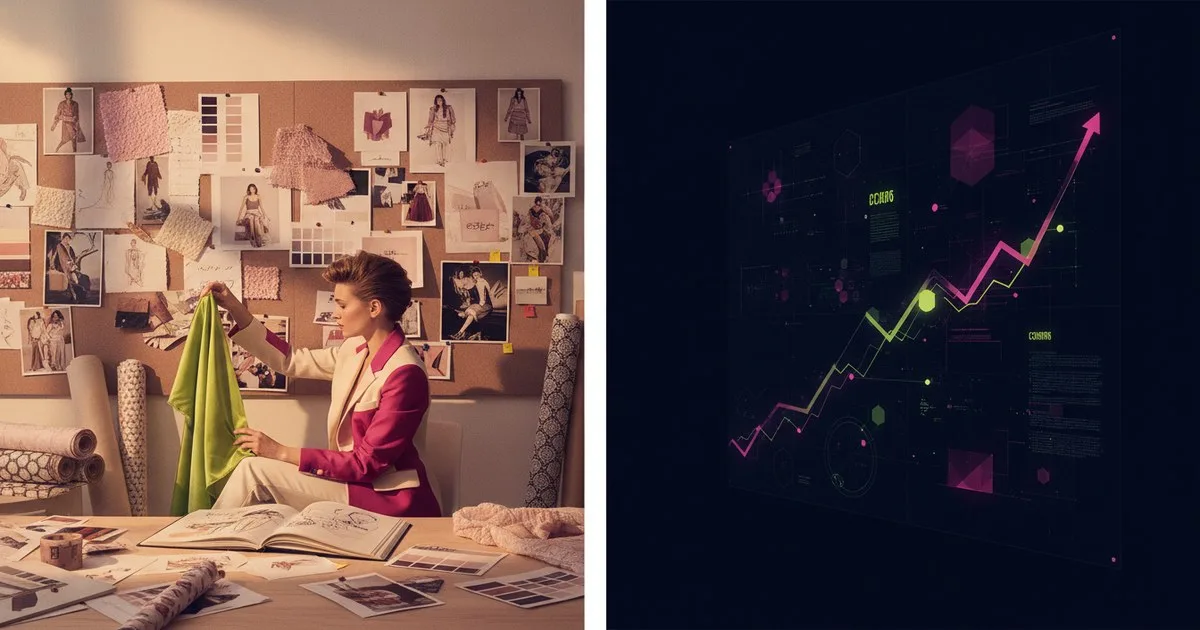
When researchers sat down to compare big-data fashion forecasting with the traditional method — human experts studying runways, trade fairs, and cultural signals — the results did not land the way most people in the industry expected. Big data is faster and cheaper to scale, but accuracy is a more complicated story, and the research makes clear that neither camp has won.
Key takeaways
- A peer-reviewed comparison of paired womenswear forecasts found meaningful differences in how big-data and traditional methods perform across different trend categories.
- Traditional forecasting still holds an edge for long-cycle, culturally nuanced trends that require contextual interpretation.
- Big-data methods outperform on short-cycle, high-volume signals — the kind that move fast on social media and in search data.
- Neither method reliably predicts disruptive or entirely new trend categories before they emerge.
- Hybrid approaches, combining algorithmic signal detection with human editorial judgment, are where the most credible forecasters are heading.
What do we actually mean by 'traditional' and 'big-data' forecasting?
Traditional trend forecasting is the method that shaped the industry for decades. A team of specialists — trend directors, cultural analysts, buyers — travels to fashion weeks, visits fabric fairs, monitors street style, and synthesises everything into a seasonal report. The output is qualitative: mood boards, colour stories, silhouette directions, narrative rationale. The timeline is long, often 18 to 24 months ahead of the retail floor.
Big-data forecasting replaces or supplements that human pipeline with algorithmic processing of large datasets. The inputs vary by provider but typically include social media image and text analysis, search-query volumes, e-commerce click and purchase data, and sometimes satellite or foot-traffic signals. Machine learning models find patterns across millions of data points and surface trend candidates ranked by momentum scores.
The two approaches are not just different tools — they rest on different assumptions about where trend signals live and how far in advance they can be read.
What did the research actually compare?
A peer-reviewed study published in the International Journal of Fashion Design, Technology and Education set up a direct comparison: 20 paired womenswear trend forecasts for the U.S. retail market in the spring 2018 season, one set generated by WGSN using its data-driven methodology and one set produced by a traditional forecasting approach. Researchers then measured how accurately each set predicted what actually appeared on the retail floor.
The findings were more nuanced than a simple 'winner.' Big-data forecasts performed better on trend categories with strong, measurable online signals — colours and prints that were already building momentum in social media and search before the season. Traditional forecasts performed more reliably on silhouette and construction trends, which tend to move through the supply chain more slowly and are harder to detect in consumer-facing data.
Critically, both methods struggled with the same category: genuinely emergent trends that had no prior signal footprint. When something new enters the market without a predecessor, neither algorithm nor expert reliably sees it coming.
Why does big data struggle with cultural context?
Algorithms are very good at counting. They are less good at interpreting. A spike in leopard-print searches might mean the trend is ascending — or it might mean a celebrity wore it once and the moment will pass in a week. Distinguishing between those two scenarios requires contextual knowledge that is difficult to encode.
Research from the USC Illumin journal notes that data modelling tools, including seasonality analysis and linear regression models, are effective at extrapolating from past data but are structurally backward-looking. They can tell you what happened and project a continuation; they cannot tell you when a cultural shift will break the pattern.
This is the core limitation. Fashion trends are not purely statistical phenomena — they are cultural ones. A colour that reads as 'nineties revival' in one market reads as 'fresh' in another. A silhouette that signals luxury in one demographic signals costume in another. Human forecasters carry that interpretive layer; models have to be explicitly trained on it, and training data for cultural nuance is hard to label at scale.
Where big data genuinely outperforms
For short-cycle trend categories — micro-trends that live and die within a single season — big-data methods have a real structural advantage. They can detect a rising signal in social image data weeks before a traditional forecaster would catch it in a trade publication or street-style report. That speed matters enormously in fast-moving retail categories.
There is also a coverage advantage. A team of human analysts can monitor a finite number of markets, subcultures, and platforms. Algorithmic systems can process millions of images and posts simultaneously, across dozens of markets, in real time. For a global brand trying to understand regional variation in trend adoption, that breadth is genuinely difficult to replicate with human labour.
Heuritech, now operating as part of Luxurynsight's luxury data-intelligence platform after its acquisition in December 2024, built its approach around exactly this strength: computer-vision analysis of social images to detect trend signals at scale, giving brands demand forecasts grounded in what consumers are actually wearing and sharing rather than what editors predict they will want.
The hybrid model: where serious forecasters are landing
The honest conclusion from the research is that the framing of 'big data versus traditional' is itself a little misleading. The most credible forecasting operations today are not choosing one method — they are layering them.
The typical hybrid workflow looks something like this:
- Signal detection — algorithmic tools scan social platforms, search data, and e-commerce behaviour to surface emerging patterns and rank them by momentum.
- Editorial filter — human analysts review the flagged signals for cultural coherence, market fit, and longevity potential. They discard noise and add context.
- Directional synthesis — the filtered signals are combined with longer-cycle intelligence (runway analysis, trade fair reporting, macro cultural observation) to produce a forecast with both short-term and long-term components.
- Continuous calibration — as the season progresses, in-season sell-through data feeds back into the model, adjusting confidence scores on active trends.
This is not a perfect system. The handoff between algorithmic output and human judgment is still largely manual, and the quality of the synthesis depends heavily on the skill of the analysts doing the filtering. But it outperforms either method alone on the metrics that matter most to buyers and planners: accuracy at the category level, lead time, and the ability to flag both fast-moving micro-trends and slower macro shifts.
What brands are actually doing with this
The research gap between forecasting method and on-the-floor execution is where things get interesting. A brand like Arc'teryx — part of Amer Sports and known for technical outdoor and urban apparel across its Arc'teryx, Veilance, and other divisions — operates in a category where trend cycles are longer and product development timelines are constrained by technical performance requirements. For that kind of brand, traditional long-cycle forecasting still carries significant weight; a Gore-Tex shell takes years to develop, and a social-media micro-trend is not a useful input at that lead time.
Contrast that with a fast-fashion or direct-to-consumer brand operating on eight-week design-to-floor cycles. For those businesses, real-time social signal analysis is not a nice-to-have — it is the only method that fits the timeline.
The lesson is that forecasting method should follow business model. There is no universally correct answer, which is part of why the research findings are so context-dependent.
What neither method has solved
Both approaches share a structural blind spot: they are better at tracking trends than at predicting them. Even the most sophisticated algorithmic system is detecting signals that already exist in the data — which means, by definition, the trend has already started. The question is how early in its lifecycle the system catches it.
For traditional forecasting, the equivalent problem is confirmation bias. Human analysts are pattern-matchers, and experienced ones are very good at finding the patterns they are already looking for. Genuinely novel categories — the kind that require abandoning a prior mental model — are hard for expert intuition to surface.
The Heuritech approach to AI-driven trend forecasting acknowledges that technology has changed the information environment fundamentally: the democratisation of fashion through social media and live-streamed collections means that trend signals are now generated by consumers as much as by editors. That shifts the advantage toward data-driven methods for consumer-facing trend detection — but it does not resolve the deeper problem of predicting what has not yet appeared.
FAQ
Is big-data forecasting more accurate than traditional forecasting?
It depends on the trend category. Big-data methods outperform on short-cycle, high-volume signals visible in social and search data. Traditional methods hold up better for silhouette and construction trends with longer development cycles. Neither is consistently more accurate across all categories.
What is WGSN and how does it forecast trends?
WGSN is a trend forecasting service that has incorporated data analytics alongside its traditional editorial research. It was used as the big-data benchmark in a peer-reviewed comparison of 20 paired womenswear forecasts for the spring 2018 U.S. retail season.
Can AI predict a trend before it starts?
Not reliably. Algorithmic systems detect signals that already exist in data, meaning a trend has already begun by the time it is flagged. The advantage is speed of detection, not genuine prediction of trends with no prior footprint.
What is a hybrid forecasting model?
A hybrid model combines algorithmic signal detection — scanning social images, search data, and sales behaviour — with human editorial judgment that filters for cultural coherence and longevity. Most serious forecasting operations now use some version of this layered approach.
Does forecasting method matter for all fashion brands equally?
No. Brands with long product development cycles, like technical outerwear, rely more on long-cycle traditional intelligence. Brands with short design-to-floor timelines benefit more from real-time data signals. The right method depends on the business model.
Further reading
- Traditional vs. big-data fashion trend forecasting — International Journal of Fashion Design, Technology and Education
- Applications of Technology in Fashion Trend Forecasting — USC Illumin
- Trend forecasting with AI: Fashion's way forward — Heuritech