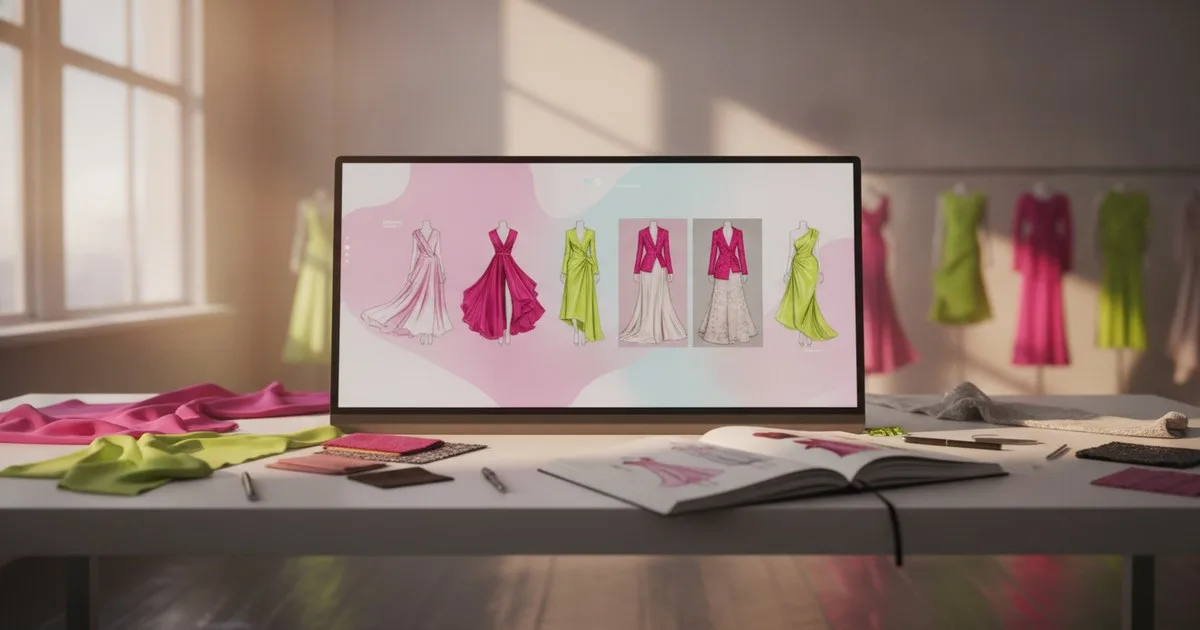
Design teams at fashion brands are no longer asking whether AI belongs in the studio — they are asking which tools are actually worth integrating. The category has matured quickly: sketch renderers, generative concept platforms, 3D simulation suites, and digital material libraries each solve a different problem in the development pipeline. This list profiles ten tools brand designers and creative directors are actively evaluating right now, with a plain-language breakdown of what each one does, who it suits, and where it falls short.
Key takeaways
- AI design tools in 2026 span at least four distinct workflow stages: concept generation, sketch rendering, 3D simulation, and material digitisation — and most tools do only one or two of these well.
- Brands we speak to report the biggest time savings come from compressing the gap between a mood-board idea and a shareable visual, not from automating final production files.
- End-to-end platforms that connect creative generation to PLM data are an emerging category, but they require existing enterprise infrastructure to deliver their full value.
- Choosing the right tool depends less on feature lists and more on where your team's bottleneck actually sits — at ideation, visualisation, or handoff to technical development.
- Most tools reviewed here offer free trials or tiered plans, making low-risk pilots feasible for teams of any size.
Which AI tools are fashion brands actually evaluating in 2026?
1. Raspberry AI
Raspberry AI is an end-to-end generative design platform built specifically for retail product design. Designers can gather and organise trend research, test ideas against synthetic customer groups, and generate retail-ready assets — including 2D technical drawings, CAD files, and product images — within a single workflow. The platform uses its own in-house models and fine-tuned ControlNets to keep outputs retail-ready rather than purely illustrative.
Beyond concept generation, Raspberry AI extends into 3D avatar-to-photorealism rendering, virtual try-on, print and graphic generation, lifestyle and product photography, multi-view generation, and a video studio. The ambition is to unify design, product, and marketing teams from first sketch to final campaign asset.
Best for: Brand teams that want a single platform covering concept through campaign, particularly those whose bottleneck spans both creative development and marketing asset production.
Limits: The breadth of the platform means teams with a very focused need — say, only sketch rendering — may find it more than they require and face a steeper onboarding curve.
2. NewArc
NewArc offers an AI-powered design visualisation tool that lets designers upload a sketch or base product and experiment with colours, materials, shapes, and textures to see how a design may look in real life. The workflow is deliberately tactile: you start with something you already have and iterate from there, rather than generating from a blank prompt.
For designers who think through drawing rather than writing prompts, this approach feels closer to the physical studio. It is particularly useful in early review meetings where a flat sketch needs to communicate more than pencil lines can.
Best for: Designers who work from existing sketches and want rapid, realistic visualisations to communicate ideas to buyers or creative directors before committing to samples.
Limits: NewArc is a visualisation tool, not a production tool — it does not output tech packs, graded patterns, or manufacturing-ready files.
3. Vizcom
Vizcom is a web-based AI design platform that lets product designers draw directly in the browser or import existing sketches, then generate 2D rendered designs or — using its 2D-to-3D feature — convert flat images into fully manipulable 3D models. Those 3D outputs can be inspected from any angle, set into scenes, and exported for presentations, AR, or manufacturing handoff.
Vizcom includes team collaboration workspaces and iterative ideation tools, making it practical for studios where multiple designers review work simultaneously. It offers tiered subscription plans including a Starter tier, making it accessible for smaller teams.
Best for: Product design teams — including footwear, accessories, and apparel — who need to move from sketch to 3D visualisation quickly and share work across a distributed team.
Limits: Vizcom is an ideation and visualisation platform; it does not generate graded patterns or connect natively to PLM systems.
4. Refabric
Refabric is an AI design platform focused on fashion concept generation and creative exploration. Designers can generate garment concepts from text or image prompts, explore colourways, and iterate on silhouettes without needing advanced prompt-engineering skills. The interface is built around the fashion design vocabulary rather than a generic image-generation tool.
Refabric positions itself as a creative accelerator for the early stages of a collection — helping designers produce a wider range of concepts in the time it would previously take to sketch a handful by hand.
Best for: Design teams in the concept and mood-board phase who want to explore more directions before committing to a direction for development.
Limits: Like most concept-generation tools, Refabric outputs are starting points, not finished technical assets — a separate workflow is needed to move from generated image to production specification.
5. Centric AI Studio
Centric AI Studio is the generative AI platform for product creation built by Centric Software, which operates as part of Dassault Systèmes. Announced in May 2026, it is fully integrated with Centric PLM and enables brand teams to generate and refine concepts, visualise assortments, accelerate development, and create launch-ready assets within connected workflows spanning design, development, merchandising, sourcing, and digital commerce.
The key differentiator is the PLM connection: creative generation is tied directly to trusted product data and operational workflows rather than sitting in a separate creative tool that requires manual handoff.
Best for: Enterprise brands already running Centric PLM that want AI-assisted concept generation embedded in their existing development and merchandising workflows.
Limits: The value proposition depends heavily on Centric PLM adoption — teams not already in that ecosystem will not benefit from the integrated workflow and face significant implementation investment.
6. Marvelous Designer
Marvelous Designer, now part of CLO Virtual Fashion, is a 3D clothing design and simulation tool built around pattern-based garment construction. Designers create garments by drawing pattern pieces and simulating how fabric drapes on a 3D avatar, with physics-based cloth simulation that accounts for fabric weight and behaviour. The 2025.1 release introduced an AI Pose Generator in beta and a Pattern Drafter that converts measurement points or flat sketches into patterns.
For teams that need to visualise fit and drape before cutting a single sample, Marvelous Designer compresses the sampling cycle meaningfully. It is widely used in both fashion and entertainment (game and film costume design).
Best for: Design teams focused on fit development, drape visualisation, and reducing physical sampling rounds — especially those working with complex or structured garments.
Limits: The pattern-based workflow has a learning curve for designers not already familiar with 2D pattern construction; it is not a quick-start tool for non-technical creatives.
7. Swatchbook by CLO
Swatchbook, now part of CLO Virtual Fashion, is a cloud-based platform for sourcing, managing, and visualising digital materials. Brands, designers, and suppliers use it to build digital fabric libraries, collaborate on material selection, and preview how textiles render in 2D and 3D environments. As part of CLO's ecosystem, Swatchbook materials can flow directly into CLO and Marvelous Designer simulations.
For brands managing large seasonal fabric libraries across multiple suppliers, the ability to centralise digital swatches and connect them to 3D simulation tools reduces the back-and-forth of physical swatch requests.
Best for: Brands and sourcing teams that manage complex fabric libraries and want digital material visualisation integrated with 3D garment simulation.
Limits: Swatchbook's value compounds when used alongside other CLO Virtual Fashion tools; as a standalone material library it is useful but not transformative.
8. Figma Weave
Figma Weave — formerly Weavy AI, acquired by Figma in late 2025 — is a node-based AI canvas that lets creative professionals chain multiple AI models (from providers including Google, OpenAI, and Runway) with professional editing tools such as outpainting, relighting, inpainting, upscaling, and compositing into scalable visual workflows. Weave tools are also available directly inside the core Figma platform.
For fashion brand creative teams already working in Figma for lookbook layouts, campaign planning, or digital asset production, Weave adds generative AI capabilities without requiring a separate tool subscription or workflow.
Best for: Creative and marketing teams at fashion brands that already use Figma and want to add AI-assisted image generation and editing to existing design workflows.
Limits: Weave is a creative production and campaign tool, not a garment design tool — it does not understand fashion construction, patterns, or technical specifications.
9. Backbone PLM
Backbone PLM, now operated under Bamboo Rose following its 2023 acquisition, is a fashion product lifecycle management platform targeting retailers managing private-label at scale and growing brands. It provides PLM tooling for product development workflows including tech packs, approvals, and supplier collaboration — the structural backbone that connects creative decisions to production reality.
While not an AI design tool in the generative sense, Backbone PLM is increasingly part of the AI design conversation because it is where the outputs of creative tools need to land. Teams evaluating AI sketch tools also need to ask how those outputs connect to their PLM.
Best for: Scale-up fashion brands and private-label retailers that need structured product development workflows and supplier collaboration tooling.
Limits: Post-acquisition integration work has reportedly absorbed engineering capacity, which may affect the pace of new feature development for existing customers.
10. Gerber AccuMark (now under Lectra)
Gerber AccuMark is a CAD pattern-making and marker-making software suite, now part of Lectra following the 2021 acquisition. It is used by apparel manufacturers worldwide for production-ready pattern creation, grading, and fabric nesting. Lectra is integrating AccuMark into its broader SaaS and cloud portfolio and promoting interoperability with Lectra Modaris, while moving toward subscription-based delivery.
For brands whose design process ends with a pattern that must go into cut-and-sew production, AccuMark remains one of the most established tools for the technical handoff from design to manufacturing.
Best for: Apparel manufacturers and brands with in-house technical teams that need production-grade pattern-making, grading, and marker-making capabilities.
Limits: AccuMark is a technical production tool, not a creative or generative AI tool — it sits at the end of the design pipeline, not the beginning.
Which tool fits which kind of team?
| Tool | What it is | Best for | Limits |
|---|---|---|---|
| Raspberry AI | End-to-end generative design platform | Full-pipeline brand teams | Broad scope may overwhelm focused use cases |
| NewArc | Sketch-to-visualisation tool | Designers iterating from existing sketches | No production file output |
| Vizcom | Sketch-to-2D/3D render platform | Multi-discipline product design teams | No PLM integration |
| Refabric | Fashion concept generation | Early-stage collection exploration | Outputs require separate technical development |
| Centric AI Studio | PLM-integrated generative AI | Enterprise Centric PLM users | Requires existing Centric PLM infrastructure |
| Marvelous Designer | 3D garment simulation | Fit development and sampling reduction | Learning curve for non-technical designers |
| Swatchbook by CLO | Digital material library | Brands with complex fabric sourcing | Most valuable inside the CLO ecosystem |
| Figma Weave | AI canvas for creative production | Campaign and marketing creative teams | Not a garment or pattern tool |
| Backbone PLM | Product lifecycle management | Scale-up brands and private-label retailers | New feature pace may be slower post-acquisition |
| Gerber AccuMark (Lectra) | Pattern-making and marker-making CAD | Technical production teams | End-of-pipeline tool, not generative |
What should design teams ask before adopting any of these tools?
The most common mistake brands make is evaluating AI design tools by feature count rather than by workflow fit. Before committing to a pilot, it is worth mapping exactly where time is lost in your current process. If the bottleneck is communicating a sketch to a buyer, a visualisation tool like NewArc or Vizcom will move the needle faster than a full PLM-connected platform. If the problem is the volume of concepts your team can explore before a range review, a generative tool like Raspberry AI or Refabric addresses that directly. And if the issue is the gap between a creative decision and a production-ready file, the conversation shifts to PLM integration and technical CAD.
Data on consumer preferences and trend signals can also sharpen the brief before any AI tool touches it — teams that feed clearer creative direction into generative tools consistently report better outputs than those using AI to replace the brief entirely.
FAQ
Which AI fashion design tools work for small design teams with limited budgets? Vizcom offers a Starter tier, and Refabric and NewArc both provide accessible entry points. Small teams benefit most from tools focused on a single stage — visualisation or concept generation — rather than end-to-end platforms that assume larger infrastructure.
Can any of these tools replace a technical pattern maker? Not yet. Tools like Marvelous Designer and Gerber AccuMark (under Lectra) assist technical development significantly, but production-ready patterns still require a skilled technician to validate fit, ease, and construction logic before going to a factory.
How do AI design tools connect to PLM systems? Most creative and visualisation tools do not connect natively to PLM. Centric AI Studio is the clearest exception, being built directly into Centric PLM. For other tools, the connection typically requires manual export and re-entry into a PLM like Backbone PLM.
What is the difference between a sketch renderer and a generative design tool? A sketch renderer (NewArc, Vizcom) takes an existing drawing and produces a realistic visual from it. A generative design tool (Raspberry AI, Refabric) creates new design concepts from a text or image prompt. Both are useful, but they solve different problems in the design process.
Are these tools safe to use with proprietary design archives? Data handling varies by platform. Enterprise buyers should review each vendor's data isolation and privacy policies carefully before uploading proprietary sketches, patterns, or fabric libraries. This is particularly important for brands with significant IP in their archive.
Further reading
- Investing in Raspberry AI — Andreessen Horowitz
- Vizcom 2D to 3D documentation
- Centric AI Studio announcement